 By Ray Bennett
Oscar-winning American composer Elliot Goldenthal, who turns 70 today, said that the first time he saw the sheet music for Krzysztof Penderecki’s ‘Threnody to the Victims of Hiroshima for 52 Strings’ when he was 17, he turned pale and started to tremble. ‘It was a deep moment. I realised that I had seen my first real film score.’
Speaking at the 2018 Krakow Film Music Festival, with the venerable late Polish composer sitting next to him on a speaker’s panel, he described spending an afternoon at Penderecki’s home with its bucolic surroundings. ‘We didn’t exchange many words but the silences – in music we call them rests – the rests were more poignant,’ Goldenthal said. ‘He has the ability to inspire. His music goes out, he doesn’t know where the wind will take it. For me, it took it to Brooklyn when I was growing up.’
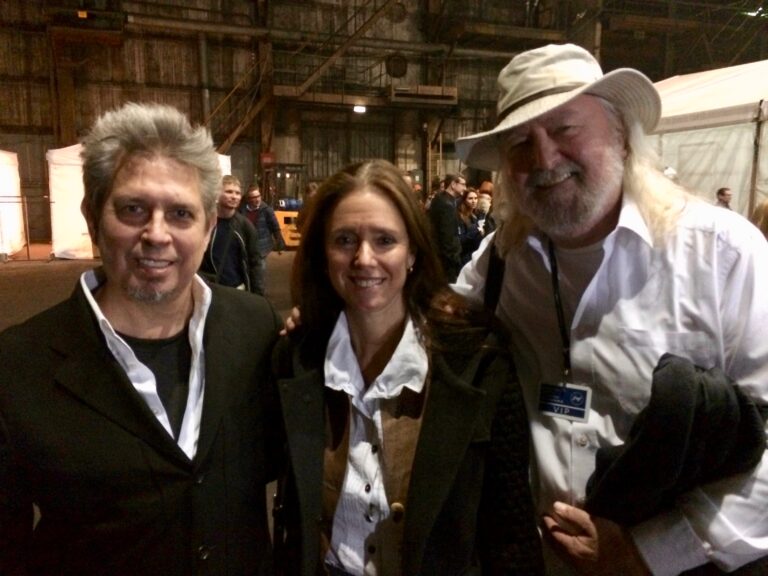
Goldenthal occupies a special place among my favourite providers of film music. I have spent time with him and his life partner, director Julie Taymor (pictured below with Elliot and me), at Abbey Road during recording sessions for her movie ‘Titus’; talked to him at length about his scores for other films of hers such as ‘Frida’, ‘The Tempest’, ‘Across the Universe’ and ‘The Glorias’ and joked and laughed into the night over drinks at the World Soundtrack Awards in Gent, Belgium, and the FMF in Krakow, Poland.
Elliot won the Academy Award for ‘Frida’ and he was nominated for best score for Francis Ford Coppola’s ‘Interview with a Vampire: The Vampire Chronicles’ and Neil Jordan’s ‘Michael Collins’. He scored Jordan’s ‘The Butcher Boy’ and ‘The Good Thief’ amid a range of films that include ‘Alien3’, ‘Batman Forever’, ‘Batman & Robin’ and ‘Heat’. Busy in the concert hall, Goldenthal composes chamber music and writes symphonies, ballets and operas. As well as the Oscar, he has won two Golden Globes, three Grammy Awards and two Tony Awards.
Robin Williams once told me that there were movie stars ‘and then there’s Jack’, as in Nicholson. At the 2014 FMF in 2014, a special concert showed that there are film composers and then there’s Elliot, as in Goldenthal.
He created for the festival a stupendous 20-minute piece titled ‘Grand Gothic Suite’ with cues from ‘Batman Forever’ and ‘Batman and Robin’ performed during the ASCAP 100th Anniversary closing gala in the vast central hall of an enormous building once called the Vladimir Lenin Steelworks.
It remains a functioning factory known as the Tinning Plant of Arcelor Mittal Poland. For the festival, it was converted to a concert hall with four thousand seats, a stage big enough for full orchestra and chorus and a giant movie screen. What the venue lost in acoustics, it more than made up for in atmosphere.
Played with evident joy by the Beethoven Academy Orchestra and Polish Radio Choir conducted by Diego Navarro, the suite soared and danced and rampaged and almost blew the roof off the Tinning Plant venue not because it was loud but because it was so enthralling. It stopped the show.
Audience and orchestra leapt to their feet and demanded that Goldenthal (in the centre of the photo above) go to the stage for a prolonged standing ovation.
As Julie Taymor, told me afterwards, the suite showed that dumb action movies can have scores that are created with classical orchestral foundations. Goldenthal has an extraordinarily rich musical vocabulary and he employed it fully in the ‘Grand Gothic Suite’. It was so vividly descriptive and evocative that you didn’t actually need to see the movies.
Two-time Oscar-winner Hans Zimmer had to follow that with a suite from Christopher Nolan’s hit movie ‘Inception’ suite and later he recalled ‘the great and redoubtable Elliot Goldenthal completely and utterly wiping the floor with us with his extraordinary, brilliant “Batman” suite! I just love that man’s music… and he triumphed that night!’

Marlon Brando: the man behind the myth
LONDON – The myth surrounding Marlon Brando, who was born 100 years ago today, has centred not only on his brilliant acting in films such as ‘A Streetcar Named Desire’ (with Vivien Leigh above), ‘On the Waterfront’, ‘The Godfather’ and ‘Apocalypse Now’ but also his eccentric ways and latterly immense girth.
It’s instructive to recall what he was like as a young man when he burst into worldwide fame on stage and screen. When he made his first movie – ‘The Men’ (below left) in 1950, a story about disabled war veterans – Brando spent six weeks living in a hospital ward of paraplegic soldiers. Determined to recreate their reality on film, he shared their lives and won their confidence.
‘You poor man,’ she told the actor. ‘Wouldn’t you like to walk again? I have the power.’
Brando decided to play along, Higham writes: ‘Marlon let out a long sigh and stood up pretenting to be a little shakey. Then, slowly but surely he began to dance around the room terminating with a frenzied jig that had all of the veterans hysterical with laughter.’
The depth of the actor’s feelings for those undefeated soldiers is in every frame of ‘The Men’ and that night says a lot about Marlon Brando – the man, not the myth. He was always a curious mix of animal magnetism, intellectual irony and childlike mirth. Born in Omaha, his acting instincts and impish nature were soon revealed. He excelled at swimming and American football and when he moved to New York in 1943 to study acting his physique was a plus. His electrifying success in the Tennessee Williams play ‘A Streetcar Named Desire’ on Broadway in December 1947 owed as much to his sex appeal as it did to his obvious acting prowess.
At first, Brando did not relate to his British leading lady, Vivien Leigh, as he found her delivery to be affected and false. According to Higham, her very English manners bothered him so much that he demanded, ‘Why are you so fucking polite?’
That all changed when the actor learned that Leigh was suffering from tubeculosis. Leigh biographer Anne Edwards writes, ‘Brando would sing folk songs for her in a pleasant voice and do imitations of Laurence Olivier (Leigh’s then husband) as Henry V.’
Leigh won an Oscar for her performance as did Hunter and Karl Malden. Brando was nominated but lost to Humphrey Bogart in ‘The African Queen’. In 1954, it was a different story with ‘On the Waterfront’ (with Rod Steiger above). A gritty drama about corruption in the longshoremen’s union in New York’s dockland, it survives today as a forceful depiction of betrayal enhanced by brilliant acting. At the time, for the liberal Brando it was a reminder of betrayal of anoter kind.
Brando hated ‘On the Waterfront’ according to Higham and for years went into a rage whenever Kazan’s name was mentioned although supposedly he later forgave him. They both won Academy Awards and Brando accepted his Oscar from Bette Davis. ‘I can’t remember what I was going to say for the life of me,’ the actor said. ‘I didn’t think ever in my life that so many people were so directly responsible for me being so very, very happy.’
Such was Brando’s pre-eminence that even today his next film, ‘Guys and Dolls’ – Joseph L. Mankiewicz’s film version of the Frank Loesser musical ‘Guys and Dolls’ based on writer Damon Runyon’s stylised New York gangster stories – is noted more for his appearance than the Frank Sinatra vehicle it might otherwise have been.
It was not the first time Brando had a fight on a movie set. On the 1962 picture ‘Mutiny on the Bounty’, he went through three directors. Carol Reed walked away after Brando objected to the script making Captain Bligh the main focus rather than his rebellious character Fletcher Christian. Trevor Howard (with Brando above left) told me years later that Reed would not suffer Brando’s tantrums. Howard said he got along with his co-star but lamented the change in the direction of the script, which came in fits and starts from Hollywood. Lewis Milestone compleated most of the film but finally quit in exasperation so George Seaton directed the climax of the film.
The film was a flop but Brando seemed to find peace in the South Pacific. After notoriously failed marriages, he settled on an island there leaving only to make a series of cinematic bombs. It was not until he made ‘The Godfather’ (above) in 1972 that he redeemed himself.
Director Francis Ford Coppola bought Mario Puzo’s bestselling gangster novel and immediately actors from Danny Thomas to Burt Lancaster made it known they were available for the role of family patriarch Don Corleone. Coppola wanted one of two actors – Laurence Olivier or Marlon Brando.
Brando agreed to audition and while the story of his stuffing his cheeks with tissue paper has been disputed, he landed the role. During production, his impish humour surfaced and he got into ‘mooning’ contests with co-stars James Caan and Robert Duvall but it became clear that his work on the film was remarkable.
It was largely downhill after that although ‘The Formula’, ‘A Dry White Season’, ‘The Freshman’ and ‘Don Juan DeMarco’ made up for dross such as ‘The Island of Dr. Moreau.’ Some of us remain fond of earlier pictures such as ‘The Young Lions’, ‘One-Eyed Jacks’, ‘The Ugly American’, ‘Reflections in a Golden Eye’, ‘The Night of the Following Day’, and ‘The Missouri Breaks’.
He died aged 80 on July 1 2004