THEATRE REVIEW: Paul Lucas’ ‘The Dice House’

dice x650

By Ray Bennett

LONDON – The inmates are definitely in charge of the asylum in Paul Lucas’s lively variation on the theme created by Luke Rhinehart in his 1970s American novel, “The Dice Man,” in which fate is handed entirely over to chance.

The setting has been Anglicized, not to say Monty Pythoned, with the principal action taking place in a rural establishment run by a psychiatrist named Ratner (Neal Foster) whose patients allow every significant move they make to be decided by a throw of the dice.

In the case of Polly (Lucy Scott), this meant she has abandoned a quiet middle-class life; deserted her husband; dresses always in pin-up outfits; and copulates with whomever the dice chooses. She is encouraged in this by her shrink who himself dresses according to the dice’s whims, which largely lean towards gymslips and leather.
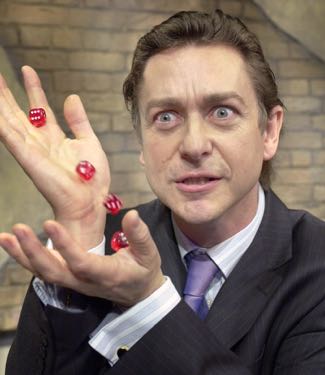
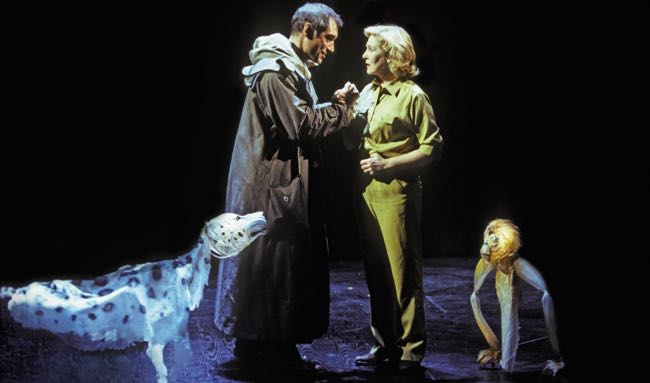
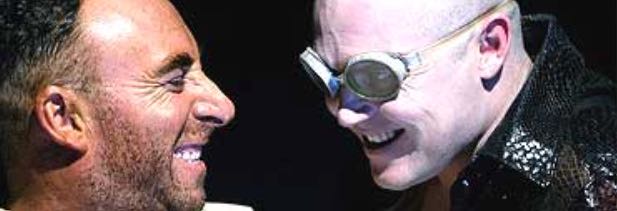
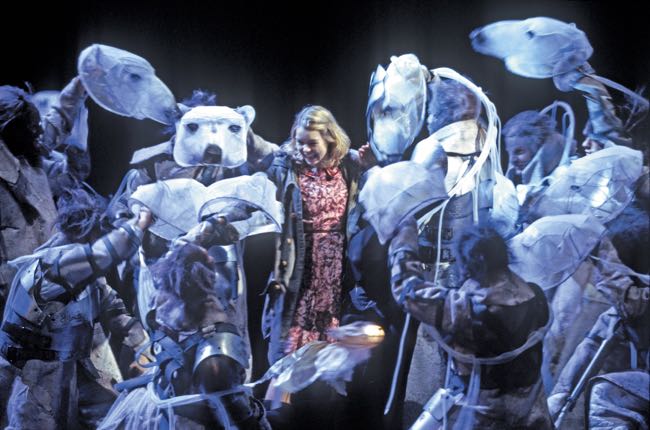
dice x325Distressed by her actions, Polly’s psychiatrist husband, Dr. Drabble (Jeremy Crutchley, pictured left),  blackmails one of his patients to kidnap her. As Dr. Drabble also is a thoroughgoing loony with murder on his mind, and his patient, Matthew (Matthew Noble, pictured top with Scott), likes to tie up innocent victims in ribbons, their arrival at the Dice House only adds to the farcical permutations.

There is a fairly serious philosophical reflection beneath the comedy having to do with freedom of choice and predestination. Ratner is given to declare that to use dice to decide things “returns a wonderful sense of uncertainty” to life. Good luck, he argues, is only “a temporary absence of misfortune”.

Dr. Drabble calls these sentiments “the incoherent ramblings of a deviate clown” but when push comes to shove he’s willing to put his trust in the dice too.

Lucas provides his cast with some darkly amusing dialogue: “Why is it that people who claim to have had previous lives are always wide-eyed lunatics in this one?” and “It’s always pleasing when random events conspire to ruin the plans of people you can’t stand.”

The cast gets into the spirit of things winningly with physical comedy to match the verbal sparring. It’s a revelation at the end of the first scene as to who is the patient and who the doctor as Jeremy Crutchley’s Dr. Drabble is quite obviously and hilariously out of his mind.

Matthew Noble as the put upon kidnapper grows from bemusement to become a beacon of almost sanity as he meets the young woman (Celia Meiras) who was his lover in a previous life.

Neal Foster, with a rigidly straight back in his assortment of ill-fitting women’s clothes, plays Ratner as a stern but quite cracked schoolteacher. Lucy Scott, in vinyl bustier with stockings and suspenders, is fetching and funny as the quiet matron turned strumpet.

There are some other very odd characters including an old codger named Smith, played heartily by Neil Boorman, who gives proof to the maxim that even paranoids have enemies as he loses body parts to a dedicated assassin as the evening goes along. And there’s James Low, very convincing as a deluded chap named Victor who remains dangerous even after four lobotomies.

Director Graeme Messer keeps things moving over 110 minutes and if the farce isn’t entirely free flowing, it is great fun.

Venue: Arts Theatre, runs through April 4; Cast: Jeremy Crutchley, Matthew Noble, Celia Meiras, Neil Boorman, Neal Foster, Lucy Scott, Benedict Martin, James Low; Playwright: Paul Lucas; Director: Graeme Messer; Designer: Norman Coates; Lighting: David W. Kidd; Music: Matthew Scott; Sound designer: Tom Lishman; Presented by Dice House Productions Ltd.

This review appeared in The Hollywood Reporter. Photos by Ian Tilton.
Posted in Reviews, Theatre | Comments Off on THEATRE REVIEW: Paul Lucas’ ‘The Dice House’

THEATRE REVIEW: ‘His Dark Materials Parts 1 & 2’

HisDarkMaterials 5 x650

By Ray Bennett

LONDON – For kids and adults who like to read children’s books, Philip Pullman’s “His Dark Materials” trilogy of fantasy novels are second in popularity only to the Harry Potter stories.

They are rich with colorful characters with exotic names, high adventure in far-flung places, mystical creatures, bears that speak, witches that fly and parallel worlds that can be crossed into only with a magical knife.

Mounting them on stage has taken every skill that the National Theatre can muster and the result is an epic production on a vast scale, comprising two 3-hour shows that may be seen on the same day or split between separate dates.

his dark materials 1 x650

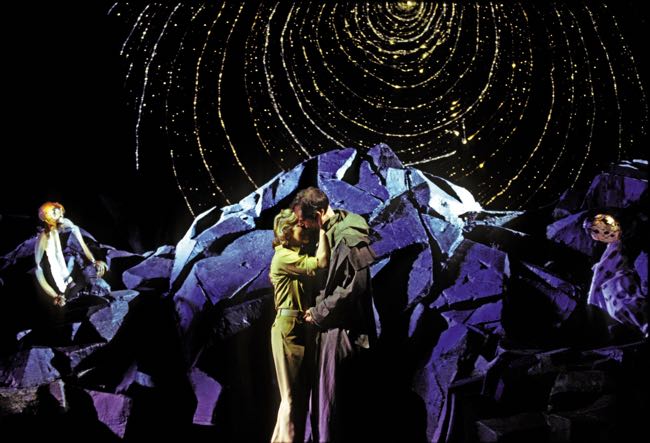
The large space of the National’s Olivier Theatre is employed  fully for a sequence of massively impressive sets, designed by Giles Cadle, that rise, spin and fall, going from an Oxford college to an arctic vista, from a mad scientist’s laboratory to a marvelously spooky descent of a rowboat to the land of the dead.

We are in a world where humans have daemons that take animal form as opposed to the inner demons we’re used to. And daemons are not evil, far from it, although they are the target of the church, which in Pullman’s world is the chief villain.

his dark materials 4 x650

There is no mention of Catholicism but there is talk of a Pope although the papal seat is in Geneva. Its leader, the President of the Consistorial Court, oversees an outfit called the General Oblation Board, which seeks to rob children of their daemons and end their search for the “dust” of individuality, knowledge and reason.

At the center of the story is an abandoned child, Lyra Belacqua (Anna Maxwell Smith, pictured top), whose uncle, Lord Asriel is a sort of Intergalactic Jones, an adventurer whose goal is to end the church’s oppression and bring about a Republic of Heaven

So it’s all a bit “Paradise Lost” with echoes of “The Wizard of Oz” and bits of “The Lord of the Rings” and Harry Potter thrown in. But the fate of the girl, played with great verve and at times considerable poignancy by Anna Maxwell Martin, is wholly captivating as she discovers who her parents are, grows to love a boy from a parallel world, and learns that her fate is to be a modern Eve.

his dark materials 2 x650

Despite the huge sets, which could easily overwhelm, the humans mostly come off well. Dominic Cooper is appealing as the girl’s reluctantly heroic lover, Will. Timothy Dalton commands the stage as the reckless adventurer although Patricia Hodge (pictured above and below with Dalton), as a vassal of the church who changes sides midway, is less threatening than she might be.

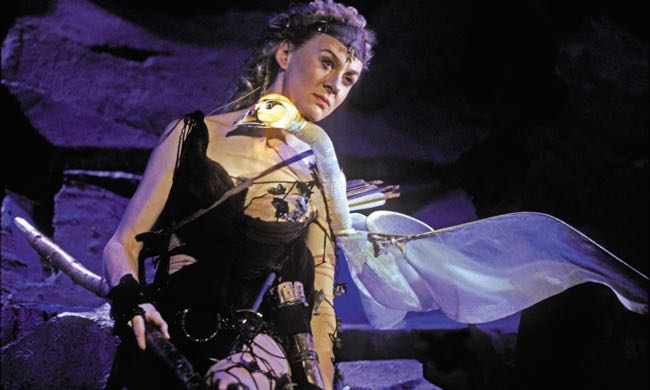
Niamh Cusack (pictured above) is radiant as Serafina Pekkala, Queen of the Lapland Witches; John Carlisle is a splendidly oily Lord; Stephen Greif employs an eerily American accent as the head of the church; Danny Sapani is magisterial as a one of a breed of armored Polar bears who has lost his armor, and Nick Sampson and Jason Thorpe have fun as a duo of camp angels.

Jon Morrell’s splendid costumes, especially for the bears and a group of strikingly nasty harpies, and Michael Curry’s highly inventive puppet designs also deserve great praise. Most of the daemons are seen as animal heads with flowing cloth bodies manipulated by actors on stage dressed and masked in black. They shimmer and cavort with their eyes glowing, bringing much humor with them.

There are also fully formed miniature puppets, flying and racing, with their puppeteers dark figures behind them. Brilliantly imagined and rendered, they earn some of the heartiest laughter from the audience.

Despite its length and the size of its ambition, “His Dark Materials” is surprisingly easy to watch. Its epic sweep allows time for tender and funny moments, and some scenes, especially when the two young protagonists discover they are condemned to live in separate worlds, that are very moving.

Pullman’s message is essentially the simple one that it’s important to live life to the full without worrying about a later reward. It’s wrapped up in vast amounts of enjoyable tosh that becomes increasingly muddled but that really doesn’t matter. When Lyra and Will have that magical knife and whole new worlds beckon, the fun of it will do very nicely.

Venue: National Theatre, runs through March 27 and will return next winter; Cast: Anna Maxwell Martin, Samuel Barnett, Dominic Cooper, Timothy Dalton, Emily Mytton, Nick Sampson, Patricia Hodge, Ben Wright, Tim McMullan, Patrick Godfrey, Russell Tovey, John Carlisle, Danny Sapani, Stephen Greif, Niamh Cusack, Cecilia Noble, Chris Larkin, Nick Sampson, Jason Thorpe; Based on the novels by Philip Pullman, adapted by Nicholas Wright; Director: Nicholas Hytner; Set designer: Giles Cadle; Costume designer: Jon Morrell; Puppet designer: Michael Curry; Lighting designer: Paule Constable; Choreographer/Assoc. director: Aletta Collins; Music: Jonathan Dove; Music director: Steven Edis; Fight director: Terry King; Sound designer: Paul Groothuis.

This review appeared in The Hollywood Reporter. Photos by Ivan Kyncl.

Posted in Reviews, Theatre | Tagged , , , , , , , , , , , , , | Comments Off on THEATRE REVIEW: ‘His Dark Materials Parts 1 & 2’

THEATRE REVIEW: David Hare’s ‘The Permanent Way’

PermanentWay1 x650

By Ray Bennett

LONDON – When successive Conservative governments under Margaret Thatcher and John Major sold off most of the nationalised British rail system to private industry, former Tory prime minister Harold Macmillan described it as “selling off the family silver”.

David Hare’s powerful new documentary play about the impact of privatizing Britain’s railway system argues that it has not only robbed the country of a reliable train service but also made traveling on it very dangerous.

“Britain!” a passenger declares in the opening scene: “A beautiful country, shame we can’t run a railway.”

Central to Hare’s argument are four rail disasters that have occurred in Britain over the past six years and his play is largely based on interviews he’s done with bereaved family members of people who lost their lives in those crashes and with survivors.

Nine cast members play various roles from the businessmen who planned the rail takeover to politicians, engineers, policemen and campaigners for survivors and the bereaved.

PermanentWay7 x650

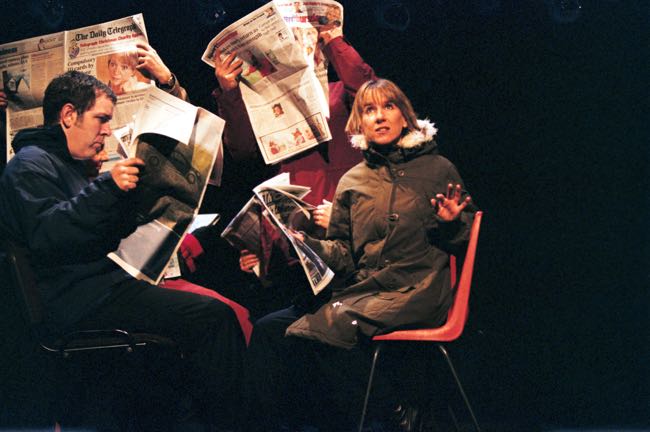
Director Max Stafford-Clark employs a stage bare except for chairs but uses a video backdrop that at first evokes the romantic view of trains chuffing across English countryside but later depicts a high-speed crash complete with searing sound effects.

For much of the time, the video screen shows a railway station timetable board displaying the routes of the trains that crashed, causing many deaths and scores of injuries.

The tone is set in the opening scene in which nine passengers await a train and express their disparate but mostly angry views of the railways directly to the audience.

In privatizing British rail, the rolling stock and passenger services were sold with geographic monopolies to an assortment of companies. The entire track — the permanent way — and responsibility for its maintenance went to another company called Railtrack.

All of the companies had seven-year licenses and part of Hare’s case is that this arrangement was a recipe for the triumph of profit over people. When the disasters occurred, all involved fled from responsibility leaving a hapless government minister to say, over and over, “This must never happen again.”

As Hare documents, it not only continued to happen but investigations proved meaningless and response to those who suffered loss or injury in the crashes was negligible.

The mother of a boy crushed to death in one rail disaster says simply, “My son was destroyed.” Another parent comes across a new acronym: VOL, meaning “value of life,” for how civil servants could evaluate the cost figure of someone who died. “They even asked me how much he spent at Christmas,” she says.

It is powerful stuff and while the politics of a domestic railway system sounds parochial, Hare’s topic is as much about the way a society deals with its responsibility for the care and safety of its citizens.

There is bleak humor in many spots and stark grief as the play gains pace over 110 minutes much like a train gathering speed. The cast is uniformly fine but Lloyd Hutchinson (pictured top with Bella Martin) stands out for the bluff characters he plays plus his wicked mimicry of a Richard Branson-like entrepreneur and British deputy minister John Prescott.

Sam Graham and Flaminia Cinque (pictured above) are harrowing as bereaved parents; Ian Redford’s depiction of a top Railtrack executive catches the man’s ambivalence and defensiveness and Kila Markham plays a campaigning solicitor persuasively.

Hare’s Broadway plays have included “Plenty,” “The Secret Rapture” and “The Blue Room,” and he scripts movies such as “The Hours” and the upcoming adaptation of Jonathan Franzen’s “The Connections.” It’s impressive that he has taken the time to craft an angry political play that may not travel well but is essential viewing in Britain.

Not only that, but he continues to update “The Permanent Way” to keep it fresh, which is more than can be said for the people who run British railways.

Venue: National Theatre, runs through May 1; Cast: Ian Redford, Nigel Cooke, Bella Merlin, Souad Faress, Lloyd Hutchinson, Sam Graham, Matthew Dunster, Flaminia Cinque, Kika Markham; Playwright: David Hare; Director: Max Stafford-Clark; Lighting designer: Johanna Town; Sound designer: Paul Arditti; Co-production between Out of Joint and the National Theatre.

This review appeared in The Hollywood Reporter. Photos by John Haynes.

Posted in Reviews, Theatre | Tagged , , , , | Comments Off on THEATRE REVIEW: David Hare’s ‘The Permanent Way’

THEATRE REVIEW: R. C. Sherriff’s ‘Journey’s End’

Journey's End 2 x650

By Ray Bennett

LONDON – That war is hell is not a new theme in the theatre, or anywhere else. That World War I was an especially foul kind of hell is also not new but in R. C. Sherriff’s “Journey’s End” it is authentic as the play is based on the author’s own experience on the front line.

Sherriff was at St. Quentin, France at the time of the Germans’ last great offensive of the war. He wrote the play in 1929 and so this revival celebrates its 75th anniversary. His setting is stark, an officers’ dugout less than 100 yards from the enemy front line.

In command is young Capt. Stanhope, a gifted winner in all life’s races who’s been at the front “far too long” and fears he’s losing his mettle, steeling it with whisky. Bracing him loyally is the older Lt. Osborne, known as uncle, whose stalwart bonhomie steadies the men around him, especially Stanhope, as they await the German onslaught.

Then arrives fresh-faced young 2nd Lt. Raleigh who not only hero-worshipped Stanhope at school but also is the brother of the captain’s fiancé. Terrified that Raleigh will portray him to his sister as a drink-sodden wreck, Stanhope fights the impulse to put the younger man in harm’s way while at the same time threatening at gunpoint another officer he believes is malingering due to cowardice.

The tension ramps up when the company is ordered to make a raid behind enemy lines in order to bring back a prisoner to be interrogated ahead of the coming offensive. Two officers are to lead the raid.

This was a war of cruel paradoxes and astonishing bravery to achieve worthless ends – to win patches of land that would be abandoned a week later. The soldiers were “the men” and officers were “chaps” who everyone knew would “put on a good show.” The men lived in watery, rat-infested trenches. The chaps had cots in the dugout with a servant to cook and make tea. There was whisky and champagne, and when they ran out of a condiment, say pepper, a signalman could be ordered to run down to headquarters to fetch some.

It’s stiff upper lip stuff where being shelled every day “tells on a man rather badly,” and it’s easily lampooned. In fact, Rowan Atkinson’s television comedy series “Blackadder Goes Forth” mocked it mercilessly. But here director David Grindley gives it his full respect and so do his actors.

Geoffrey Streatfeild is not quite shockingly young enough for the courageous but shattered Stanhope but he skirts cleverly close to the madness, his ashen features and shell-shocked expressions reminiscent of a young Leslie Howard or Robert Donat.

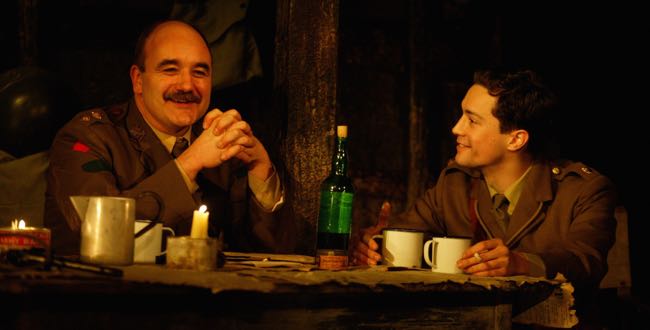
David Haig brings to the ill-fated uncle both gravitas and a convincing acceptance of a fellow’s need to do the decent thing. Christian Coulson (pictured with Haig) is suitably dashing and appropriately dismayed by events as the new young officer and Ben Meyjes is persuasive as the cowardly Hibbert.

Designer Jonathan Fensom’s finely detailed dugout set is claustrophobic and unsettling, safe haven promising imminent threat. And Gregory Clarke’s sound design is outstanding in evoking the terror outside and at the end the mounting clamor as the bombardment commences.

Grindley freezes his cast at the final curtain as statues in front of a wall of the names of the fallen. The image bears the searing austerity of genuine memorials on the battlefields of World War I, and gives Sherriff’s worthwhile play a resonance it fully deserves.

Venue: Comedy Theatre, runs through May 1; Cast: Geoffrey Streatfield, David Haig, Guy Williams, Phil Cornwell, Christian Coulson, Paul Bradley, Alex Grimwood, Ben Meyjes, Guy Williams, Rupert Wickham, Max Berendt, John R. Mahoney, Alex Grimwood; Playwright: R.C. Sherriff; Director: David Grindley; Designer: Jonathan Fensom; Lighting designer: Jason Taylor; Sound designer: Gregory Clarke; Casting: Sam Jones; Fight director: Paul Benzing; Dialect coach: Majella Hurley; Music advisor: Annette Battam; Presented by Phil Cameron for Background.

This review appeared in The Hollywood Reporter.

Posted in Reviews, Theatre | Tagged , , , , , , , | Comments Off on THEATRE REVIEW: R. C. Sherriff’s ‘Journey’s End’

MUSIC REVIEW: Ennio Morricone’s 75th birthday concert

Ennio Morricone conducting x650

By Ray Bennett

LONDON – The machine-gun drum of his Oscar-nominated score for “The Untouchables” opened Ennio Morricone’s 75th birthday concert at the Royal Albert Hall on Nov. 10 and signalled that the Italian maestro’s film music enthrals even without the pictures.

Stately and commanding upon the conductor’s podium, Morricone directed the 94-piece Roma Sinfonietta and massed voices of the Crouch End Festival Chorus in an almost three-hour review of some of his most memorable scores.

To demonstrate his seriousness of purpose, the pieces were separated into four sections, “Life and Legend” and “The Modernity of Myth in Sergio Leone’s Cinema” in the first half, and “Social Cinema” and “Tragic, Epic and Lyrical Cinema” in the second.

Morricone employed his original film orchestrations and followed the “Untouchables” rat-a-tat-tat with the plangent strings of “Once Upon a Time in America”. That led to the clarinet intro to his astonishing work for “The Legend of 1900”, which soon soared with strings and horns and the pulsating power of six bull fiddles and nine cellos.

Solo harpist Vincenzina Capone took over before muted trombones teased into the full orchestra and then emerged the piano of Gilda Butta and the beautiful melody from “Cinema Paradiso”.

morricone-cd-75birthday2003What marks Morricone’s music, besides his peerless ability with melody, is his inventive use of found instruments. Here, he used musical instruments to replicate those sounds but they still sounded fresh, from the piccolos’ coyote cry of “The Good, the Bad and the Ugly” to the soaring chorale and violins of “ The Ecstasy of Gold”.

“The Good, the Bad and the Ugly” surprises with its smooth beginning before the instantly recognisable cues break forth. Morricone’s mastery in evoking visual images in music are demonstrated once and forever in his breathtaking score for “Once Upon a Time in the West”. Soprano Susanna Rigacci’s heartbreaking solo rode within and above the surging full chorus over music that echoed sagebrush and a wild frontier, filled with yearning.

From the romance of the west, Morricone turned in the second half to the realities of such films as “Battle of Algiers”, “Sacco and Vanzetti”, and “Casualties of War.” Portuguese fado singer Dulce Pontes lent her emotion-filled voice, wrenching in its purity, to these scores. Pontes used her Fado improvisation on other classical Morricone pieces, as she does on their new Universal album, “Focus”, in which Morricone allowed lyrics to be set to some of his most popular works.

Elsewhere, the concert matched Morricone’s own new Warner Bros. Release, “Arena Concerto”, taken from performances in various Italian cities. Both albums reflect the Italian’s passion for film music that not only illuminates cinema but stands boldly on its own.

His orchestrations put every member of the Sinfornietta to work and revealed the newly refurbished acoustics of the Royal Albert Hall in all their spectacular glory. You could taste the ashes of battle during “Casualties of War” and it was impossible not to be moved by the full power of orchestra and chorus in the inspiring “The Mission”.

In one of the many standing ovations at the end, the sell-out crowd insisted on singing “Happy Birthday” to Morricone and you were left to wonder how it is possible that this remarkable septuagenarian doesn’t yet have an Oscar.

This story appeared in The Hollywood Reporter but is not available on thr.com. For more about the concert 


Posted in Film, Music, Reviews | Tagged , , , | Comments Off on MUSIC REVIEW: Ennio Morricone’s 75th birthday concert

THEATRE REVIEW: ‘Thoroughly Modern Millie’

millie03 x650

By Ray Bennett

LONDON – A clutch of Tony Awards doesn’t always mean that a Broadway show will win over British audiences but “Thoroughly Modern Millie”, which won six including best musical, has succeeded where “City of Angels”, “Grand Hotel”, “Ragtime” and many others failed.

The shows origins were inauspicious – George Roy Hill’s bulky and unwieldy 1967 comedy starring Julie Andrews and Mary Tyler Moore. Elmer Bernstein won an Oscar for his score to the picture but there weren’t many songs aside from James Van Heusen and Sammy Cahn’s toe-tapping title tune.

New songs for the stage version by Dick Scanlan and Jeanine Tesori aren’t really in the same league but they are bright and peppy and serve the story well, making for light-as-a-feather entertainment.

The story, with book by Richard Morris and Scanlan, is a piece of fluff typical of the form, wherein Kansas-girl Millie arrives in Manhattan in the Roaring Twenties determined to find a rich husband but ends up falling in love with a likable loser. Naturally, there’s a twist in the tale.

millie02 x650

It’s not a show that you think should work as it appears to be constructed from bits and pieces of other shows but it succeeds thanks to David Gallo’s sensational Art Deco design, spectacular choreography by Rob Ashford, quicksilver direction by Michael Mayer and some splendid talent onstage, especially Amanda Holden in the title role.

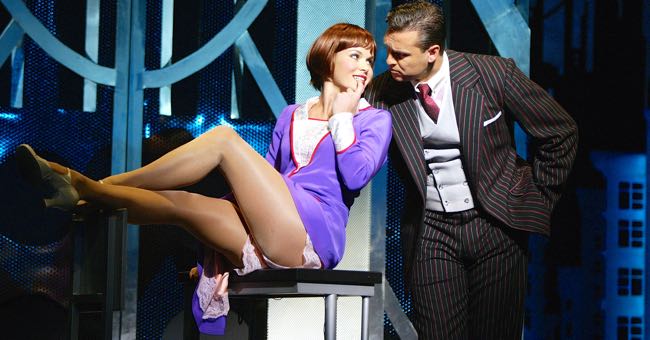
Holden (pictured top with Craig Urbani) is a British television star making her first West End splash as a leading lady and she proves she’s the genuine all-singing, all-dancing article when she’s so good-looking she could probably just stand there. Big-screen cameras will adore her.

Surrounding Holden are an accomplished troupe who not only display the polish of seasoned performers but share her delight in making it all seem fresh and new. Veteran Maureen Lipman gets into the spirit of things with a lively, if corny, take on the New York hotel manager who dabbles in delivering gullible young girls to the Chinese slave trade.

There is much mugging in pigeon-Chinese with two Chinese performers (Unku and Yo Santhaveesuk) in for good measure but while at first blush the joke is a bit thin, it proves irresistible by the time the three burst out in a heavily accented version of “Mammy”.

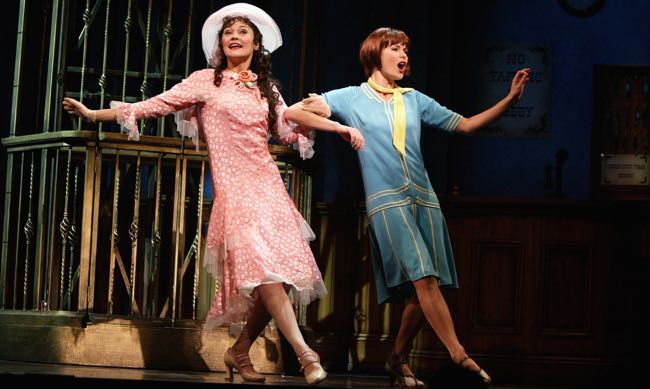
Helen Baker (pictured above with Holden) is a sprightly partner in Millie’s adventures and Craig Urbani, as the rich object of Millie’s attentions, and Mark McGee, as the poor boy who falls for her, are both skillful performers with Urbani displaying a particularly droll touch.

There are several outstanding numbers that use the full cast and the breadth of the stage including one in which Millie and her fellow stenographers sit at moveable desks, typing and tap-dancing furiously while the boss dictates a hugely complicated memo. Such showstoppers bring out the best in the whole company and make it difficult to leave the theatre without a smile.

Venue: Shaftesbury Theatre, London (runs through June 26, 2004); Cast: Amanda Holden; Maureen Lipman/Marti Webb; Sheila Ferguson; Craig Urbani; Mark McGee; Helen Baker; Rachel Izen; Unku; Yo Santhaveesuk; Book: Richard Morris and Dick Scanlan; New music: Jeanine Tesori; New lyrics: Dick Scanlan; Original story and screenplay for the Universal Pictures film: Richard Morris; Director: Michael Mayer; Choreographer: Rob Ashford; Set designer: David Gallo; Costume designer: Martin Paklendinaz; Sound designer: Jon Weston; Presented by Paul Elliott, Duncan C. Weldon, Pat Moylan.

Posted in Music, Reviews, Theatre | Tagged , , , , , , , , , , | Comments Off on THEATRE REVIEW: ‘Thoroughly Modern Millie’

FILM REVIEW: Stephen Fry’s ‘Bright Young Things’

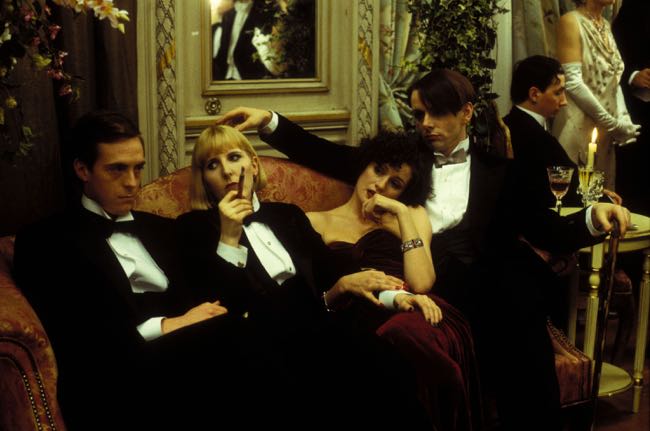
Stephen Campbell Moore plays Adam, Fenella Woolgar plays Agatha, Emily Mortimer plays Nina and Michael Sheen plays Miles BRIGHT YOUNG THINGS- For further information please contact Madalyn Bielfeld / 0207 637 2600 at McDonald & Rutter


By Ray Bennett

LONDON – Stephen Fry’s “Bright Young Things” will be judged at two levels: as an adaptation of Evelyn Waugh’s classic novel “Vile Bodies” and as a film on its own merits.

Possibly torn between the two, writer/director Fry fails at both.

Noisy, busy and frightfully giddy, the film makes a stab at “Moulin Rouge” territory but ends up as an annoying mish-mash with terribly keen chaps and dotty women charging about to little effect.

With Waugh devotees bound to be mortified by the simplistic and optimistic ending that Fry splices onto the story, and with precious few laughs, word of mouth is unlikely to be very positive and box office prospects appear dire.

Opens: UK Oct. 3; Cast: Stephen Campbell Moore, Emily Mortimer, Fenella Woolgar, James McAvoy, Michael Sheen, David Tennant, Guy Henry, Dan Aykroyd, Jim Broadbent, Stockard Channing, Peter O’Toole; Director: Stephen Fry; Writer: Stephen Fry, based on the novel “Vile Bodies” by Evelyn Waugh; Director of Photography: Henry Braham; Production designer: Michael Howells; Composer: Anne Dudley; Costume designer: Nic Ede; Editor: Alex Mackie; Producers: Gina Carter, Miranda Davis; Executive Producers: Andrew Eaton, Michael Winterbottom, Stephen Fry, Chris Auty, Neil Peplow, Jim Reeve, Steve Robbins; Not rated; running time, 106 minutes; Presented by The Film Consortium in association with the UK Film Council and Visionview and Icon Film Distribution a Revolution Films/Doubting Hall production.

Posted in Film, Reviews | Tagged , , , , , , , , , , , , , , , | Comments Off on FILM REVIEW: Stephen Fry’s ‘Bright Young Things’

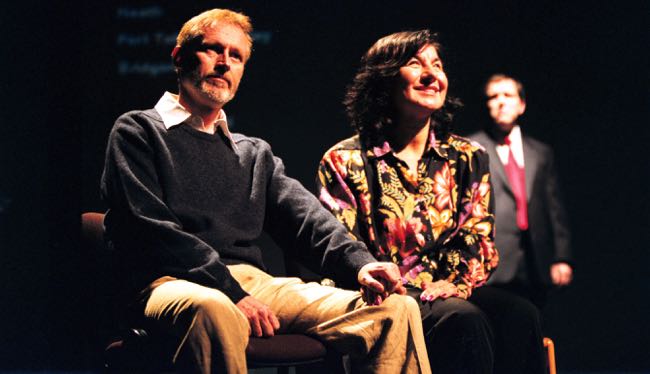
THEATRE REVIEW: Michael Frayn’s ‘Democracy’

democracy 2 x650

By Ray Bennett

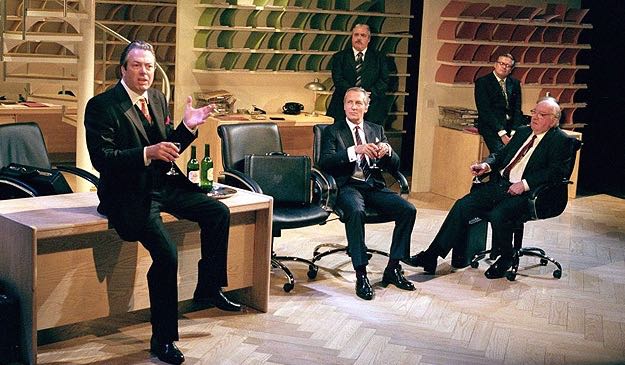
LONDON – Michael Frayn’s absorbing new play has a straightforward surface as it look at the years from 1969 to 1974 when Willy Brandt, played by Roger Allam, was chancellor of West Germany until he was brought down by an East German spy who worked as his personal assistant.

Frayn is both a humorist (“Noises Off”) and a philosopher, however, and so those historical facts prompt him to explore how the machinations of high-level politics are matched by the drives, impulses and behavior of individuals.

Beneath its surface, “Democracy” is about the complexity of human beings and it suggests in both central characters – Brandt and his betrayer, Gunter Guillaume, played by Conreth Hall (pictured top left with Allam) – that any one individual contains all the lives that he or she might once have been or could be again.

Brandt himself is presented as an ambivalent man of many identities, several of which served him well during his exile from Germany during the Third Reich. The “clean hands” with which he returned, having fought the Nazis from outside, served him well as a leader but made his fellow politicians, whose allegiances were less transparent, suspicious of him.

Frayn’s Brandt is a contemplative man, given to second-guessing himself although not when it comes to seducing as many admiring women as he can on the campaign trail nor in his view that treaties with East Germany and the Soviet Union were essential to future peace.

Guillaume, meanwhile, is the most successful espionage mole ever, establishing himself innocently in the west and only called upon to spy for the East German secret police when he lands a job with Brandt. An ingratiating if sometimes irritating toady, Guillaume makes himself indispensable to Brandt and while not ceasing to report to his Stasi masters, develops an increasing respect and affection for him.

Frayn uses a device in which Guillaume speaks over his shoulder to his control, who sits at a café at the side of the stage. Occasionally the spy joins his contact there while the action in Brandt’s office continues. Director Michael Blakemore employs Peter J. Davison’s twin-level set to great effect to further establish the divide between the characters’ interior emotions and their external actions.

democracy x650

Swirling around the two principals is a roster of political matchmakers, wheeler-dealers and spin-meisters, all with their own ambitions and alliances. Frayn’s scenes of nefarious politics are finely calibrated and there are clear echoes of the modern day White House and Downing Street.

Roger Allam is compelling as Brandt: charismatic when required to be and amiably lackluster in his most vulnerable moments. Allam’s mastery of silence on stage is remarkable. Guillaume requires a quite different tone and Conleth Hill captures his unctuous manner so convincingly as to sometimes be off-putting, but it’s a winning performance. The conniving politicos around them are played splendidly, especially by David Ryall as the wily old Herbert Wehner.

Frayn’s stagecraft is wise and his ironies subtle, and “Democracy” deserves to be seen. The play only lacks a crucial tension because in the short term Brandt and the Soviets, and their East German puppets, wanted much the same thing. In the end, of course, Brandt was proven to be right and the world became a better place. Frayn’s play is memorably instructive on how that came to be.

Venue: National Theatre, runs through Dec. 30; Cast: Roger Allam, Conleth Hill, Steven Pacey, Jonathan Coy, Paul Gregory, Paul Broughton, David Ryall, Glyn Grain, Nicholas Blane, Christopher Ettridge; Playwright: Michael Frayn; Director: Michael Blakemore; Set Designer: Peter J. Davison; Costume Designer: Sue Willmington; Lighting designer: Mark Henderson; Sound Designer: Neil Alexander; Company voice work: Patsy Rodenburg.

This review appeared in The Hollywood Reporter. Top photo by Conrad Blakemore.

Posted in Reviews, Theatre | Tagged , , , , , | Comments Off on THEATRE REVIEW: Michael Frayn’s ‘Democracy’

THEATRE REVIEW: Anthony Sher’s ‘I.D.’ at the Almeida

I.D. x650

By Ray Bennett

LONDON – “I dream of a girl waiting for me somewhere in Africa,” says Demetrious Tsafendas, a man of very mixed heritage but mostly Greek and Mozambican who appears unable to settle anywhere. Mostly that’s due to officious immigration officers and petty bureaucrats but when this much-traveled wayfarer finally settles it’s in South Africa where he assassinates the prime minister.

Noted actor Anthony Sher, in his first play, relishes exploring the true story of how Tsafendas, a temporary parliamentary messenger, came to stab to death Hendrik Verwoerd, the Dutch-born “architect of apartheid” in 1966. In Sher’s hands, it becomes a story of identity – the “I.D.” of the title – that affects everyone in South Africa in that sorry time. This includes not only Tsafendas but Verwoerd, who is portrayed as a man deeply conflicted in his own sense of identity, having been a keen supporter of Nazi Germany before going to South Africa.

For Tsafendas, rendered as a kind of sad-sack Odysseus, his Penelope is a black woman and in order to be able to woo her he claims to be mulatto in order be re-registered as “colored.” There is a jarring scene in which a uniformed jobsworth uses calipers to measure his lips and nose and pushes a pencil into his hair to see how tightly it curls.

Director Nancy Meckler uses an almost bare stage with only a desk that rises and sinks to build the landscape for what becomes an oppressively dour saga. Tsafendas served 28 years in jail for the murder and we see him encased in a narrow cage that rattles every time another convict shudders on the gallows. They are brutal images and serve to underline the terror of that time.

Sher employs another device that works less convincingly. Tsafendas claimed that he was unbalanced as the result of having borne in his body a massive tapeworm since he was young. The South African authorities actually chose to regard him as insane in order not to have the kind of trial, and outcome, that might make him a martyr.

Strangely, Sher makes the tapeworm — Lintwurm — into a living, breathing character with a bullet head and a foul mouth. It’s an odd sort of alter ego and when Tsafentas turns to speak to the Lintwurm in the middle of other scenes it becomes distracting.

This surrealism does not detract, however, from the precision of the political scenes in which officers try to justify apartheid nor from the power of the scenes of interrogation and intimidation.

Sher makes his Tsafentas a bit too much a crowd-pleaser to be entirely believable but he is well accomplished in the art of being ingratiating. As the Lintwurm, Alex Fearns is a feral if not wholly believable presence and Marius Weyers portrays the mild-mannered evil of Verwoerd with utter conviction. The remainder of the cast performs admirably and while the production lingers in the mind, the longer thought is that Sher will almost certainly write better plays.

Venue: Almeida Theatre, runs through October 18; Cast: Anthony Sher, Marius Weyers, Alex Ferns, Jennifer Woodburne; Playwright: Anthony Sher; Director: Nancy Meckler; Designer: Katrina Lindsay; Lighting designer: Johanna Town; Music: Ilona Sekacz; Movement: Scarlett Mackmin; Sound: John Leonard; South African Music Consultant: Sello Maake Ka Ncube.

This review appeared in The Hollywood Reporter. Photo by Tristram Kenton.

Posted in Reviews, Theatre | Tagged , , | Comments Off on THEATRE REVIEW: Anthony Sher’s ‘I.D.’ at the Almeida

EDINBURGH FILM REVIEW: ‘I’ll Sleep When I’m Dead’

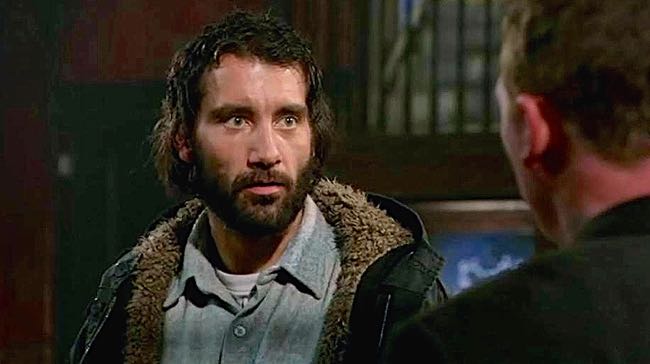
I'LL SLEEP WHEN I'M DEAD, Clive Owen, 2003, (c) Paramount Classics

By Ray Bennett

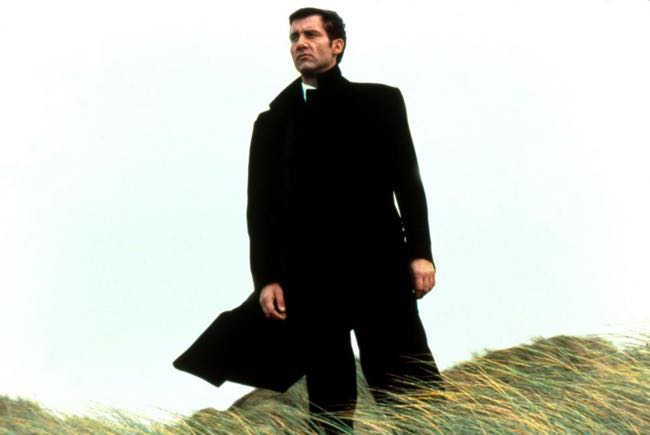
EDINBURGH – “Most thoughts are memories, and memories deceive,” says Will Graham, the central character played by Clive Owen (above and below) in director Mike Hodges’ new film. In Graham’s case, the deceptive memories are of a violent life that he seeks to erase.

Hodges, whose recent “Croupier” was well received, remains best known for his underworld classic “Get Carter,” starring Michael Caine. Like that film, “I’ll Sleep When I’m Dead” is about a toughened criminal who returns to his home to find out why his brother is dead. The new film is a far more mature work, however, filled with slow menace but also deep regret over life’s inevitabilities.

With the summer blockbusters proving limply familiar, the rich character development and inventive surprises here may prove satisfying to audiences prepared to take on a film that takes for granted their understanding that in some stories the ending doesn’t need to be told.

illsleepwhen x650

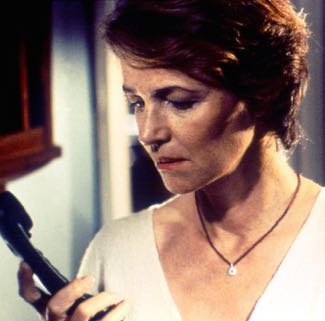
“Will Graham was the hardest man I’ve ever known,” says one of his London crew, but Graham has been gone from that city’s criminal underbelly for three years, living in a van, working pickup jobs as a logger in faraway forests. He left his charming scoundrel of a brother, Davey, and elegant mistress, Helen (Charlotte Rampling, below), and the manor he ran with an iron fist has been taken over by another hard man named Frank Turner (Ken Stott).

But Davey, played by Jonathan Rhys Meyers (“Bend It Like Beckham”), has been selling cocaine to the beautiful people and his insouciance and winning charm catch the resentful eye of a bad man. Boad, played by Malcolm McDowell, is well off and married but his ferocious envy leads him to assault and bugger Davey, who is destroyed by the rape and commits suicide.

I'LL SLEEP WHEN I'M DEAD, Charlotte Rampling, 2003, (c) Paramount ClassicsAway in his solitude, Graham’s constantly churning memories prompt him to call Davey and when he hears nothing he returns to London. When Helen is puzzled by what she sees in Graham’s bearded, haunted features, he says: “It’s grief for a life wasted. And now there’s Davey, another fucking wasted life. And I’m going to find out why.”

But while Graham pursues the man responsible for his brother’s despair, the new hard man on the patch is looking for Graham. “Frank is bad to the bone; he’s going to come for you,” he is told. The conflict is laid out in almost mythic terms with the fate-driven purpose of a classic western or samurai tale. “Don’t ever underestimate Will Graham,” Frank says. “He’s a fierce man who’ll go the distance.”

It takes strong and believable actors to deliver such lines and in Owen Hodges has a leading man entirely capable of taking on that responsibility. Already noted for “Croupier” and currently filming the title role in Jerry Bruckheimer’s “King Arthur,” Owen has a star-making role here, handsome but intelligent and all coiled anger, and he grabs it. He’s already been tipped as the next James Bond and although he may be too big a star by the time Pierce Brosnan steps down, there’s a scene in “I’ll Sleep When I’m Dead,” when Graham emerges clean-shaven and expensively tailored, that suggests 007 is his for the taking.

Rhys Meyers, too, further enhances his career with an eye-catching performance as the flamboyantly smooth-edged ruffian younger brother. Rampling adds to her recent catalogue of intriguing women and McDowell plays his villain with understated fury. Stott and Jamie Foreman, as Davey’s buddy Mickser, are equally strong.

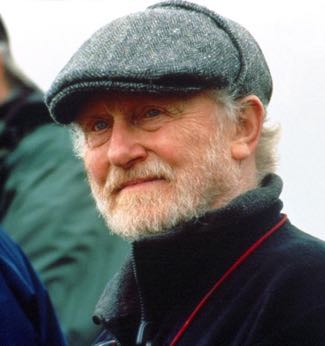
I'LL SLEEP WHEN I'M DEAD, Director Mike Hodges on the set, 2003, (c) Paramount Classics

I’LL SLEEP WHEN I’M DEAD, Director Mike Hodges on the set, 2003, (c) Paramount Classics

Trevor Preston’s screenplay charts a course that leads to unforeseen paths along the way to a conclusion that we can imagine but do not see. A key aspect of the story that he explores in ways that prove unsettling is that Davey is found to have ejaculated when he was raped. That apparently common occurrence throws a massive and confusing wrench into the self-regard of the male-bonding tough guys. The finish, too, is enigmatic but in the hands of Hodges (right) with his masterful touch in conveying how deep run the rivers of regret, “I’ll Sleep When I’m Dead” will take its place with “Get Carter” as a classic British gangster film.

Venue: Edinburgh International Film Festival;  Cast: Clive Owen, Charlotte Rampling, Jonathan Rhys Meyers, Malcolm McDowell, Ken Stott, Jamie Foreman, Sylvia Syms; Director: Mike Hodges; Writer: Trevor Preston;  Director of Photography Mike Garfath; Production Designer: Jon Bunker; Music: Simon Fisher-Turner; Costume Designer: Evangeline Averre; Editor: Paul Carlin; Producers: Mike Kaplan, Michael Corrente; Executive Producer: Roger Marino; Production: Mosaic Film Group, Revere Pictures, Will & Company; A Paramount Classics Release; A Revere Pictures/Seven Arts presentation; Rated: UK: 15; running time: 103 minutes. DVD release: UK: Momentum Pictures, US: Paramount.

This review appeared in The Hollywood Reporter.

Posted in Edinburgh International Film Festival, Film, Reviews | Tagged , , , , , , , , , | Comments Off on EDINBURGH FILM REVIEW: ‘I’ll Sleep When I’m Dead’