THEATRE REVIEW: Polly Teale’s ‘After Mrs. Rochester’

after mrs rochester 1

By Ray Bennett

LONDON – She was the mad Creole woman in the attic, the tormented creature whose existence gave Charlotte Bronte’s “Jane Eyre” its dark, Gothic power. She was Mr. Rochester’s first wife, Bertha, and her trapped rage haunts the pages of that celebrated novel.

She haunted Jean Rhys even more. Born, like Bertha, in the West Indies, to a white Creole mother, Rhys was sent to England in 1907, when her life took many dark turns before writing provided an escape. Still, it wasn’t until 1966 that she published her great novel, “Wide Sargasso Sea,” which tells the story of Bertha before she became Mrs. Rochester.
after mrs rochester 3

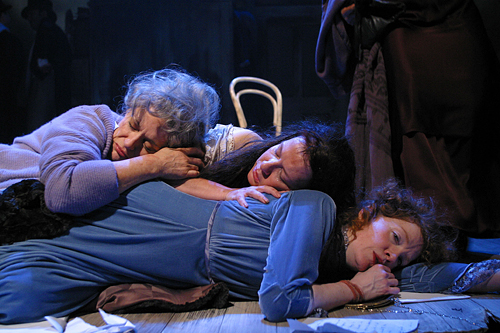
Polly Teale’s extraordinary play “After Mrs. Rochester” tells the story of Rhys’ own life and her obsession with Bronte’s Creole madwoman in a manner so vivid and evocative that it sparks an urgent need to rediscover both novels.

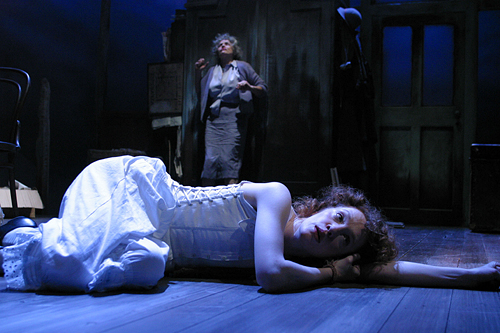
Rhys is an aging, gin-soaked recluse in Devon when we meet her. But she’s not alone as she has with her constantly Mrs. Rochester, a creature of her imagination made manifest on the stage. And as she writes, there is her young self to talk to and to remind her of the days and nights of the Sargasso Sea.
after mrs rochester 2

Many others stride through her writing room, too: her repressed and strict mother and well-meaning father, the Creole friends of her childhood, the men who choose and then abuse her and the characters from “Jane Eyre” that inspire her. “Charlotte Bronte never tasted a mango,” she says, “or saw one rot in the heat.”

Teale recounts the alienation Rhys felt as a child in the West Indies and the echoes she found in Bronte’s writing. And then being sent to cold England, where, flopping as an actress, she becomes a chorus girl, an escort and then a “kept woman.” There is an abortion, men who mistreat her and end up in jail, and then a daughter she cannot keep. Jean drinks and has fights and spends time in Holloway Prison for assault.

The play shows all this over two hours with the older Jean always onstage and her younger self living her life, her alter ego always there too. Her daughter also arrives as she strives to finish her classic novel, and at the heart of the play is their acceptance of each other.

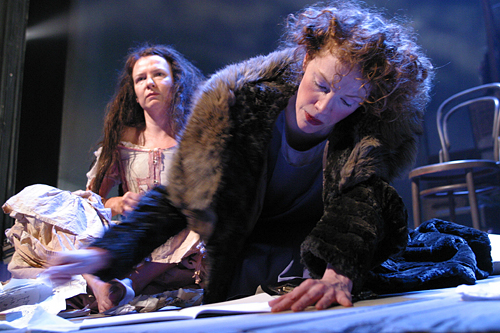
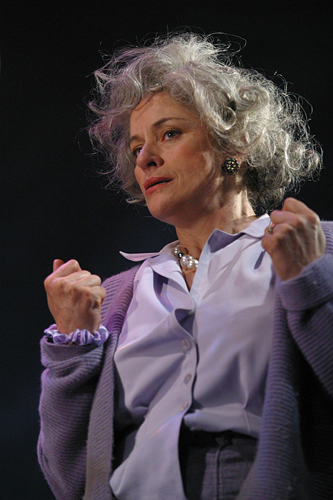
Diana Quick (above right) is a ruined glory as Jean, her voice cracked, clothes rumpled, stockings askew. It’s a magnificent performance. Madeleine Potter (top), as the young Jean, shows us what she was: vital but vulnerable, her fragile beauty obscuring the strength within. Sarah Ball is a marvel as Mrs. Rochester. At first unmoving at Jean’s feet, she becomes a tangible presence, an often feral manifestation of Jean’s torments and dreams. From something still and stiff, Ball becomes fluid and sensuous. While she is acting constantly throughout the play, she never upstages anyone.
after mrs rochester 4

The remainder of the cast is uniformly fine and each takes more than one role. Hattie Ladbury is striking as both Jean’s frightened mother and the tolerant wife of one of Jean’s admirers. Amy Marston draws eerie parallels between Jean’s daughter and Jane Eyre. Syan Blake is blithe as a childhood friend and bleak as another kept woman in London. David Annen makes clear the lines and distinctions between Jean’s father and one of her lovers, while Simon Thorp brings full measure to Mr. Rochester and another lover.

The play is produced by Shared Experience, a theatrical company noted for its attention to all elements of dramaturgy, and the production achieves a resonance that is every bit the equal of a great motion picture. The credits include one for dramaturgy, by Nancy Meckler, and for movement, by Leah Hausman.

Teale directs her own work and they combine to create an astonishing harmony of words and motion. The lighting, too, by Chris Davey, is remarkable as it achieves the tones and subtlety of great cinematography.

A critic is quoted in the play to say of Rhys’s book that it is “frighteningly alive, dark and truthful”. The same can be said of “After Mrs. Rochester”.

Venue: Duke of York’s Theatre, runs through Oct. 25; Cast: David Annen, Sarah Ball, Syan Blake, Hattie Ladbury, Amy Marston, Madeleine Potter, Diana Quick, Simon Thorp; Playwright-director: Polly Teale; Designer: Angela Davies; Movement director: Leah Hausman; Dramaturgy: Nancy Meckler; Composer: Howard Davidson; Lighting designer: Chris Davey; Ambassador Theatre Group & Maidstone Prods. present a Shared Experience production.

This review appeared in The Hollywood Reporter.
Posted in Reviews, Theatre | Tagged , , , , , , , , | Comments Off on THEATRE REVIEW: Polly Teale’s ‘After Mrs. Rochester’

THEATRE REVIEW: Kenneth Branagh in David Mamet’s ‘Edmond’

edmond4

By Ray Bennett

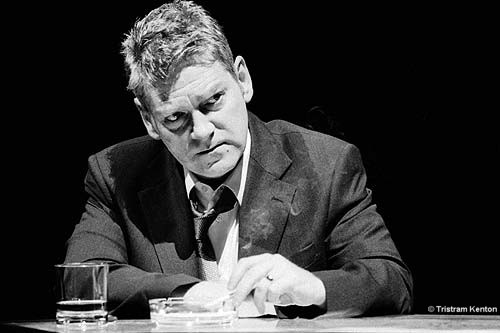
LONDON – After a decade’s absence from the London stage, Kenneth Branagh could not have chosen a better showcase for his prodigious talents than David Mamet’s pugnacious little play “Edmond”.

As the title character in Mamet’s allegory, he descends from stagnant middle-class civility into a hellish netherworld where his bourgois assymptions are tested and every bias and savage impulse is unleashed. An encounter with a fortune teller causes bland businessman Edmond to confront the emptiness in his life and marriage. His wife’s shrill complaint that the maid has broken a lamp prompts him to flee the safe boredom of his home into the quaqmire of New York’s darkest streets.

The act of leaving his wife tilts him into a freefall that allows no purchase as he sinks into a bog that he mistakes for freedom. To Edmond’s surprise, hookers are expensive, pimps are violent, and the guy who runs a three-card monte game on the street is a cheat. Still, Edmond wanders the streets and encounters big-city nightcrawlers until he is robbed and beaten and left bewildered.

“We live in a fog; we live in a dream,” he declares.

But then he turns and discovers liberation in killing a black man who has attacked him. Screeching racial hatred, Edmond finds what he thinks is a kind of peace in living in the moment. Freed, he goes home with a waitress but their riotous sex play leads to conversation. She balks at his refusal to accept her self-delusions so he knifes her bloodily to death. Undone by his crime, he seeks redemption but the salvation he finds is not so very different from the life he fled.

All this is accomplished in 75 minutes, driven by Edward Hall’s spiky direction and fleshed out by Mamet’s trademark arsenal of language with his asphalt harshness and lacerating tone. There is a large cast for a one-act play and everyone onstage catches the urgency and spirit of the production.

Tracy-Ann Oberman as Edmond’s outraged wife, Nicola Stephenson as an enthusiastic peep-show girl, Rebecca Johsnon as a matter-of-fact hook and Nicola Walker as the unfortunate waitress play off Branagh’s energy splendidly. Carol Macready makes her three roles vivid and Nonso Anozie destroys the stereotype of his massive convict at the climax.

Branagh bites into the prose and spits it our as poetry with his extraordinary ability to utter every phrase and fragment as if they were fresh-born and not from a writer’s page. Onstage throughout the play,Branagh is fearless and confidently naked – once literally – as he makes Edmond’s torment and bewilderment believable.

This is not small accomplishment as much of what Mamet has Edmond say is the direst adolescent blither; callow bleating about life, sex, love, God and fate. The play was written in 1982 and it’s hard to imagine even then that a city-dweller such as Edmond could be so naive.

There is something of Jackson Pollocl about Mamet; he appears to splash words on his canvas, often artfully, rich and colourfully. Certainly, actors relish them. When delivered by Branagh and the other first-rate actors in this production, an audience might also be enthralled.

But the words bear little examination for any lasting meaning. Pollocl’s style, but perhaps not his genius. “Edmond” is, however, a brillian actor’s showcase and Branagh does it brilliantly.

Venue: National Theatre, runs through Oct. 4; Cast: Kenneth Branagh, Tracy-Ann Oberman, Carol Macready, Nicola Stephenson, Rebecca Johnson, Nicola Walker, Nonso Anozie; Playwright: David Mamet; Director: Edward Hall; Set designer: Michael Pavelka; Lighting designer: Mark Henderson; Score/sound: Terry Davies, Paul Groothius.

This review appeared in The Hollywood Reporter.
Posted in Reviews, Theatre | Tagged , , , , | Comments Off on THEATRE REVIEW: Kenneth Branagh in David Mamet’s ‘Edmond’

THEATRE REVIEW: Simon Russell Beale in Stoppard’s ‘Jumpers’

jumpers

By Ray Bennett

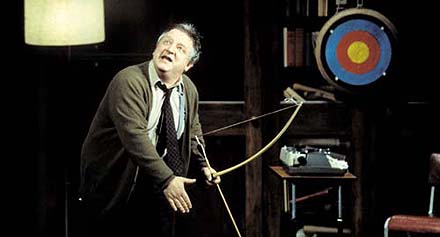
LONDON – A professor of moral philosophy named George, played superbly by Simon Russell Beale (pictured) dictates his arguments for a speech in defense of the existence of God while, in the adjacent ballroom-sized lounge of his Mayfair flat, a wild party is going on.

Star of the party is the professor’s champagne-addled wife Dorothy (Essie Davis), erstwhile first lady of musical theater, whose entertainment includes a troupe of acrobats called Jumpers, one of whom falls dead from a gunshot wound.

If that’s not the start to a farce, it’s hard to know what is. First produced in 1972, Tom Stoppard’s “Jumpers” has lost none of its zest and ability to enthrall. The Jumpers of the title are in fact fellows of the professor in academe, being led by the college’s vice-chancellor, an unctuous chap named Archie Jumper, who holds doctorates in medicine, law and gymnastics, and may also be Dorothy’s lover.

The question of who shot the dead Jumper, although it forms a sort of mystery basis for the play, is of little consequence. Like everything else in “Jumpers,'” it is simply a vehicle for Stoppard’s deft wit. In this case, the joke is on the audience, which is led to care more about the fate of a tortoise and a hare named Thumper, which George intends to use as illustrations in his speech.

Stoppard sets the earnest waffle of George’s lecture on goodness –“What is so good about ‘good’?” — against Dorothy’s sentimental reaction to men walking on the moon and Archie’s cynical pragmatism and the contrasts pay off hilariously.

George is the faculty’s “tame believer,” a man ready to argue the existence of God but afraid he’s regarded as a “joke vicar.” While capable of invoking Cantor’s Proof and Thomas Aquinas’ five proofs of the existence of God, George also finds himself asking if the question should be “Is God?” or “Are God?”

“Is God what?” asks the no-nonsense policeman Bones, called in to investigate the murder, and George is at a loss to explain. Stoppard fires on all cylinders in George’s speeches, and it is a measure of Simon Russell Beale’s wonderful performance as the professor that he makes him an intelligent as well as a well-meaning figure.

Essie Davis, who spends a considerable amount of time onstage either naked or next to it, is thoroughly diverting as Dorothy whether bewildered, in a tantrum, or spooning for the moon. Jonathan Hyde as Archie and Nicholas Woodeson as Bones are pitch-perfect.

There is little slack in David Leveaux’s direction over two hours, plus a 20-minute interval, and the action keeps pace with Stoppard’s flights of fancy, well matched by Vicki Mortimer’s moonstruck sets.

He’s been knighted since and become an Oscar-winning screenwriter (“Shakespeare in Love”), but “Jumpers” is a delightful reminder of Stoppard’s maxim that, as a character here says, “language is only an approximation of meaning.”

Venue: National Theatre, runs through Sept. 9; Cast: Simon Russell Beale, Essie Davis, Jonathan Hyde, Nicholas Woodeson, Eliza Lumley, John Rogan, Jean-Felix Callens, Jonothan Campbell, Leo Kay, Robert Barton, Gary Cross, Karl Magee, Dodger Phillips, Phil Seaman, Ashley Stuart, Lewis Young; Playwright: Tom Stoppard; Director: David Leveaux; Set designer: Vicki Mortimer; Costume designer: Nicky Gillibrand; Lighting designer: Paule Constable; Music: Corin Buckeridge; Choreographer: Aidan Treays; Music director/keyboard: Ian Townsend; Double bass: Rutledge Turnland; Drums: Michael Gregory.

This review appeared in The Hollywood Reporter.
Posted in Reviews, Theatre | Tagged , , , | Comments Off on THEATRE REVIEW: Simon Russell Beale in Stoppard’s ‘Jumpers’

THEATRE REVIEW: Roy Williams’ ‘Fallout’

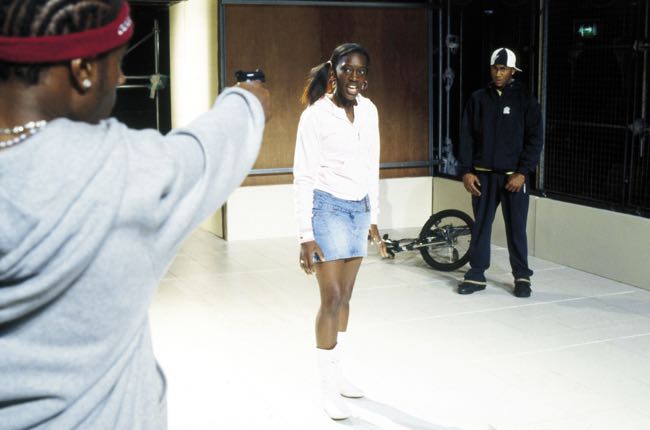
Royal Court Theatre presents FALLOUT by Roy William Directed by Ian Rickson Playing at The Jerwood Theatre Downstairs from 12 June until 12 July 2003.   For further press information, please contact: RCT Press Office on (020) 7565 5011. http://www.royalcourttheatre.com Pictured: Michael Obiora, Ony Uhiara, Marcel McCalla. Photography by Gautier Deblonde.  Please credit. Distributed on behalf of the Royal Court Theatre by EPO Online (020) 7968 1560.  Email: info@epo-online.com http://www.epo-online.com This image has been supplied for free use to accompany editorial, reviews and listings during the run of this production/cast only.  For any other uses, please contact EPO Online. Ref: 703414a

By Ray Bennett

LONDON – On an inner-city estate, in an opening more heard than seen due to clever staging, a straight-A black student is stomped to death, his head “used for a football,” his running shoes stolen.

Four young black men flee the crime, one more guilty than the others, and it is the nature of their edgy and competitive existence as smalltime gang-bangers that occupies playwright Roy Williams’ play “Fallout” more than any question of justice.

The same issues of respect and thwarted hope infect the two police officers who investigate the murder. Joe (Lennie James), a black detective constable, grew up in what the British call a “sink estate” and he hates the envy and resentment they breed toward anyone who wishes to escape. Matt (Daniel Ryan), his white detective sergeant, is a true-blue liberal who only waivers in his orderly pursuit of something resembling the truth when his constable forces the issue.

Central to the fate-driven story is the behavior of two young women involved with the tearaways. Shanice (Only Uhiara) is strong and bright and draws men and women to her confident beauty. Ronnie (Petra Letang), who is completely under Shanice’s spell, is fearful and weak and her jealousy ultimately leads to betrayal.

Stark and spare on a stage created as a rectangular pit in the round with the audience mostly looking down on the action, the play moves quickly through 1 hour and 50 minutes. For the younger characters, Williams employs a believable argot that in its derivative poverty of language argues the tragedy of their limited horizons. He uses the curt and ugly lingo in fine staccato fashion, however, creating riffs of interchanging lines that achieve a form of poetry.

Director Ian Rickson uses the empty space to full effect with fight sequences that involve bodies slamming off cages protecting the closest audience members. He draws splendid performances from a thoroughly committed cast. Ony Uhiara is outstanding as Shanice, fully aware of the power of her sexuality but torn between her own aspirations and loyalty to her friends.

Michael Obiora, as gang boss Dwayne, and Marcel McCalla, as Shanice’s troubled boyfriend Emile, convey intelligently the way their characters are mutually dependent, as leader and follower, each destined to play out his fate. James, as angry cop Joe, and Ryan, as well-intentioned Matt, bring taut intensity to their exchanges.

Williams blends in comic relief masterfully to offset what is clearly tragic. His dialogue lapses occasionally  into four-letter words and racial slurs that sound dated and unnecessary but for the most part it’s a crisp and unsentimental piece of work.

Stephen Warbeck’s music catches the urgency and sadness observantly.

Venue: Jerwood Theatre Downstairs, Royal Court Theatre, runs through July 12; Cast: Jason Frederick, Michael Obiora, Marcel McCalla, O-T Fagbenie, Lennie James, Daniel Ryan, Ony Uhiara, Petra Letang, Clive Wedderburn, Lorraine Brunning; Playwright: Roy Williams; Director: Ian Rickson; Designer: Ultz; Lighting: Nigel J. Edwards; Sound: Ian Dickinson; Music: Stephen Warbeck.

A version of this review appeared in The Hollywood Reporter. Photo by Gautier Deblonde.
Posted in Reviews, Theatre | Tagged , , , , | Comments Off on THEATRE REVIEW: Roy Williams’ ‘Fallout’

CONCERT REVIEW: Shirley Bassey’s 50th anniversary

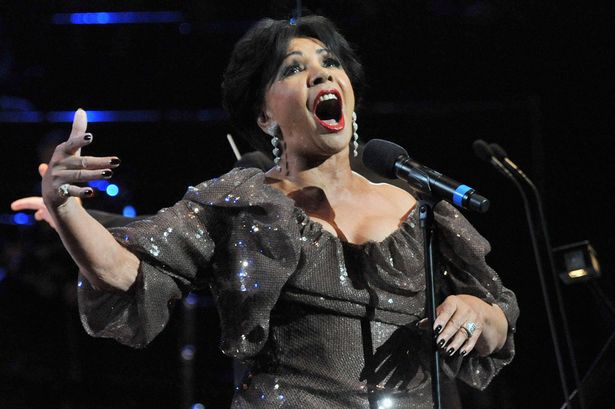
Singer Dame Shirley Bassey

By Ray Bennett

Shirley Bassey received a five-minute standing ovation just for showing up at Wembley Arena on June 14 and that set the standard for the rapturous response that greeted all 22 songs in her 105-minute set.

It was the London leg of her 50th anniversary tour and the capital’s fans were on their most demonstratively devoted behavior. Britain’s premiere pop diva responded in kind and delivered a sunnily sophisticated performance with the confidence of an artist in peak form.

Honoured last year by the Queen of England, you wouldn’t think that this gorgeous Dame, moving jauntily across the stage in a long shimmering gown with the skirt split to the thigh, was a grandmother in her 60s. Sassy and sexy and in complete control of her remarkable voice, gym-trained Bassey squatted in her high heels constantly to retrieve a steady stream of gifts delivered to the front of the stage.

“Goldfinger” set the bar high at the outset and musical director Peter Hagen put the strings and brass of his 21-piece orchestra to work in fine fashion. Bassey said she had chosen her songs from the five decades of her extraordinary career and the top songbooks were represented by such as Rodgers and Hart’s “Johnny One-Note” and “Lady is a Tramp,” Coleman and Fields’s “Big Spender,” and Jerry Herman’s “I Am What I Am.”

Always a flamboyant entertainer, the Welsh-born singer can still shiver the timbers at the back of a very large hall with something like Lionel Bart’s “As Long as He Needs Me,” arms outstretched, fingers dancing. She can kick out the jams on Al Timothy and Michael Julien’s “Kiss Me, Honey Honey” or the Doors’ “Light My Fire.” But she can bring it all down and caress the shadows with George Harrison’s “Something,” Willie Nelson’s “Crazy” and “(Where Do I Begin) Love Story” by Francis Lai and Carl Sigman.

Alex Gifford’s “History Repeating,” a ’90s hit for Bassey with the Propellorheads, was fresh and challenging and her version of Lennon and McCartney’s “Hey Jude” made it perfectly clear that you can’t sing along with Shirley Bassey unless she wants you to. Making the song her own, she took its melody and rhythm beyond reach before lowering her voice to let everyone join in.

Ebb and Kander’s “New York, New York” and Barry and Black’s “Diamonds Are Forever” got the big treatment but it was never too much, always under control. And at the end, the tears seemed genuine when Bassey sang Andy and Elizabeth Neve’s new song “Thank You For the Years,” from her new Sony album.

There were very few empty spaces at the 12,000-seat auditorium and the multi-generational crowd clearly went home happy. “Eat your heart out, Catherine Zeta Jones,” cried one fan, and no one disagreed.

This review appeared in The Hollywood Reporter.
Posted in Music, Reviews | Tagged , , | Comments Off on CONCERT REVIEW: Shirley Bassey’s 50th anniversary

FILM REVIEW: Charlotte Church in ‘I’ll Be There’

I-ll-Be-There-2003 x650

By Ray Bennett

LONDON – “I’ll Be There” follows the Elvis Presley pattern of how to introduce a hot young musical talent to the movies – in this case, Welsh classical singer Charlotte Church – and it’s the right way to go.

Like “Love Me Tender” all those years ago, it’s a lightweight picture about a love triangle with sturdy character actors, and the young star sings just four songs including the title number.

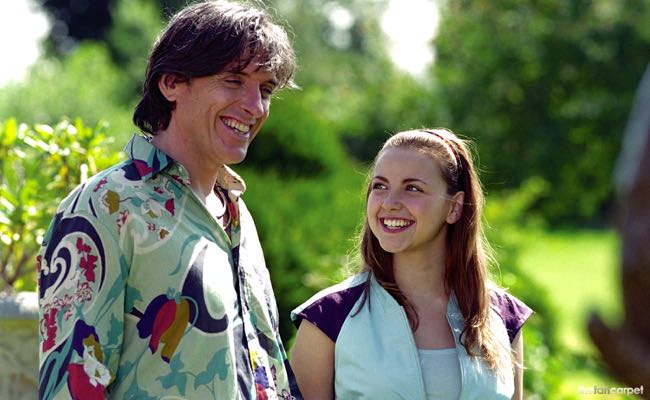
As a result, there’s little resting on Church’s shoulders and as she’s an immensely appealing teenager who can walk and talk, and especially smile, on camera at the same time, “I’ll Be There” will do her no harm.

This is a small family film, however, and unless director, co-writer and leading man Craig Ferguson’s “Drew Carey Show” fan base rallies around, it’s unlikely to excite moviegoers as much as Church excites record buyers.

Fans of the “Voice of an Angel,” whose Sony debut album of that name shipped 10 million copies around the world and was followed by three more hit releases, may even feel cheated that she doesn’t sing more.

But even though it’s innocuous and unmemorable, the film shows that Ferguson has promise as a director. It’s his first directing stint, having co-written and co-exec produced “The Big Tease” and co-written and co-produced “Saving Grace” (2000).

Ferguson (pictured with Church) plays Paul Kerr, an ’80s Scottish rocker who lives a lonely, self-destructive life in a very fancy pile in the Welsh countryside. In a nearby town lives a woman named Rebecca (Jemma Redgrave) who has a fiery old Ronnie Hawkins-style rocker named Evil Edmonds (Joss Ackland) for a father and a sweet-faced daughter named Olivia (Church) whom she has raised alone. When Kerr makes the papers for an apparent suicide attempt driving his motorcycle out of a second story window, Rebecca has to face the question of telling Olivia that her father is a drunken rock star.

Thus the love triangle as sweet Olivia and her dad meet and make up while fiercely protective mom fights to keep the girl away from the sex, drugs and rock’n’roll that made her own life so hard. But her daughter has kept a secret from Rebecca too, and of course that’s her extraordinary voice. The outcome is entirely predictable and only a likeably quirky script by Ferguson and Philip McGrade and some naturalistic playing redeem the saccharine sentiments.

Ferguson’s ageing rock star is appealing in his wasted self-regard that begins to change in a cuckoo’s nest psych ward when he leads the fellow patients in a raucous piano-led jam. As the stalwart mother, Redgrave (Corin’s daughter, of the famous dynasty) is pleasingly unglamorous and she captures Rebecca’s ambivalence toward her old love effectively.

In a story close to her real life, Charlotte Church has no great stretches to make and she handles lines and movement with the aplomb of the outstanding concert performer that she is. As the old-time rock’n’roller, Ackland is a revelation viewers will either find quite captivating or maddeningly over the top.

In the end, the film exists to set the stage for Church to sing and she does, wonderfully, Gershwin’s “Summertime” and a new tune by multi-Oscar nominee Diane Warren titled “Would I Know?”

Veteran music supervisor Budd Carr’s savvy song choices help things greatly and Ferguson shows that he has a true director’s eye with more than a few subtle touches that make the film quite endearing for all its blandness.

In the opening sequence, Church sings a gorgeous Celtic song alone in a beautiful old church and on the lectern the briefly seen text is “Apocrypha.” At the end, when all the principals get up on a pub stage to bang out the Four Tops’ “Reach Out (I’ll Be There),” the clashing styles are noisily and engagingly out of tune, just as they would be.

We can hope that having made a benign start Church will find success in films but won’t churn out the kind of movie musical pap that trapped Presley, but we can also hope that Ferguson’s next gig gives him much freer rein.

Opens: UK June 20 (Warner Bros.); Cast: Charlotte Church, Craig Ferguson, Jemma Redgrave, Joss Ackland, Ralph Brown, Ian McNeice, Steve Noonan,  Imelda Staunton, Marion Bailey, Anthony Head; Director: Craig Ferguson; Screenwriters: Craig Ferguson, Philip McGrade; Director of photography: Ian Wilson; Production designer: Tim Harvey; Music: Trevor Jones; Costume designer: Stephanie Collie; Editor: Sheldon Kahn. Producer: James G. Robinson; Executive producer: Guy McElwaine, Executive music supervisor: Budd Carr; Production: Morgan Creek; MPAA rating PG-13, running time, 102 minutes.

Posted in Film, Music, Reviews | Tagged , , , , , , , , , , | Comments Off on FILM REVIEW: Charlotte Church in ‘I’ll Be There’

THEATRE REVIEW: Toyah Willcox in ‘Calamity Jane’

Toyah Calamity Jane 1 x325By Ray Bennett

LONDON – When Doris Day blew in from the Windy City as the buckskinned tomboy in the movie “Calamity Jane,” she was ornery but toothsome and it didn’t take much for handsome Howard Keel to figure out that under all that trail dust and chapped leather was a darned tootin’, fine lookin’ gal.

That was in 1953 and times have changed although not on the stage of the Shaftesbury Theatre. The denizens of Deadwood City still sing about the Black Hills of Dakota, ogle showgirls at the local saloon and listen to Calamity Jane’s tall tales of fighting Injuns, shooting gunfighters and riding the pony express.

The show is “Annie Get Your Gun” and “Kiss Me Kate” all over again except the former had songs by Irving Berlin and the latter by Cole Porter. “Calamity Jane” has songs by Sammy Fain and Paul Francis Webster. At their high end, Fain and Webster could turn out Oscar-winning numbers such as “Love is a Many Splendored Thing” from the 1955 film of the same name, and “Secret Love” from “Calamity Jane.” Webster won a third Oscar for the lyrics to Johnny Mandel’s “The Shadow of Your Smile” from “The Sandpiper” in 1965.

“Calamity Jane” also boasts lively show pieces in “The Deadwood Stage (Whip Crack Away)” and “Windy City” and a lyrical ballad, “Black Hills of Dakota.” After that it all gets a bit grim and with 11 other songs in the show, it’s no wonder the movie is best recalled for Day’s zestful performance and lovely singing.

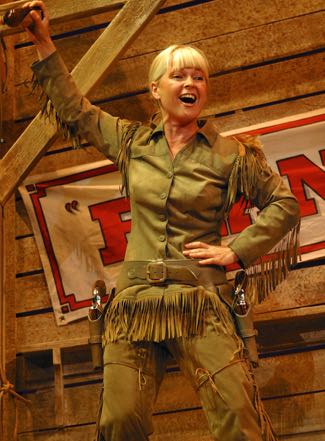
In this stage version, most of the weight falls on Toyah Willcox, a former U.K. pop and soap star, and it’s a testament to her sheer determination to ingratiate that she just about carries it. Employing an accent that combines cornpone with grits and bits of Strother Martin, Willcox bounces onstage and, leaving no surface untouched whether verticle or horizontal, keeps bouncing until the final curtain.

Ed Curtis’ lighthearted and engaging production gives Willcox lots to bounce off including two leading men, Michael Cormick, a laconic, slow-moving Wild Bill, and Garry Kilby, as a handsome cavalry officer. Cormick wins the day and the singing honors with a fine tenor voice deep enough to suggest echoes of Keel’s rich baritone.

Kellie Ryan is appealing as the maid who Jane brings back from Chicago to perform in Deadwood thinking she is a top showgirl and who promptly falls for Jane’s beloved. Secret love doesn’t stay secret for very long, though, and it’s thanks to a cast of enthusiastic pros and the tireless Willcox that what should seem tired and dated ends up simply oldfashioned and charming.

Venue: Shaftesbury Theatre, runs through Sept. 20; Cast: Toyah Willcox, Michael Cormick, Kellie Ryan, Garry Kilby, Duncan Smith, Abigail Aston, Phil Ormerol, Ahmet Ahmet; Music: Sammy Fain; Lyrics: Paul Francis Webster; Adapted for the stage by: Charles K. Freeman; Based upon the motion picture produced by: Warner Bros.; Director: Ed Curtis; Designer: Simon Higlett; Choreographer: Craig Revel Horwood; Lighting Designer: James Whiteside; Sound designer: Simon Whitehorn for Orbital; Musical director: Robert Cousins; Presented by Tristan Baker.

This review appeared in The Hollywood Reporter.
Posted in Reviews, Theatre | Tagged , , , , , , , , , | Comments Off on THEATRE REVIEW: Toyah Willcox in ‘Calamity Jane’

MUSIC REVIEW: George Fenton and ‘Blue Planet’ in Hyde Park

blue planet 1 x650By Ray Bennett

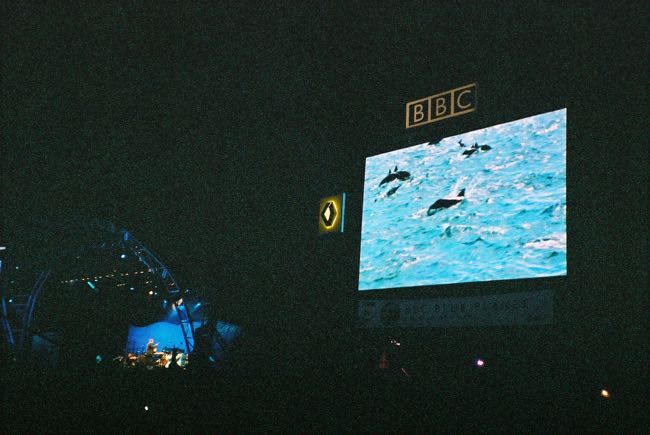
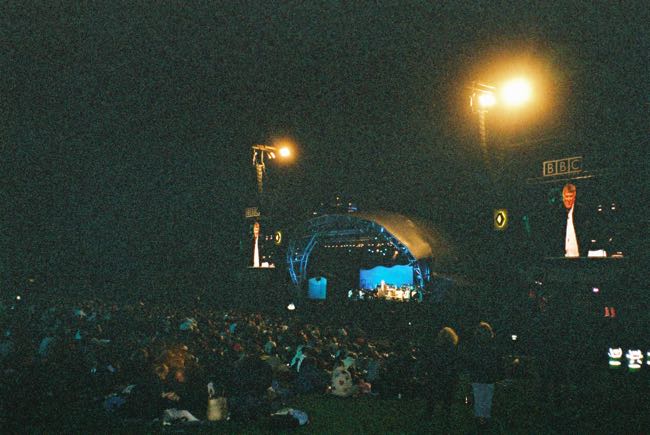
LONDON – They call Hyde Park the lungs of London and on Sunday evening there, 10,000 people took a collective deep breath and metaphorically plunged into the ocean depths to experience the marvels of “The Blue Planet.”

The occasion was an outdoor concert featuring the BBC Concert Orchestra conducted by George Fenton, playing cues from his score to the worldwide hit natural history series as scenes from the show were played on giant screens.

“The Blue Planet” is one of the most successful documentary series ever produced by the BBC. First broadcast in the U.K. last September, it has been seen in more than 50 countries including the United States where it has been a hit on the Discovery Channel.

The 9-episode series, narrated by David Attenborough, cost $11 million and took more than four years to make. It has turned into a marketing phenomenon for BBC Worldwide, the U.K. pubcaster’s commercial arm, which has exploited it in a dozen different media streams.

Through television, video, publishing, records and now concerts, “The Blue Planet” has pulled in more than $23 million, with more to come. It has already been adapted for a theatrical short, which ran in the U.K. and Australia accompanying the feature “Help! I’m a Fish,” and there are plans to adapt the series into a 90-minute feature film.

blue planet 2 x650The idea of a “Blue Planet” concert came from Jane Carter who is classical acquisition and development manager for BBC Music. “I make records, basically,” says Carter. The idea struck while attending a recording session for the series. “I saw George conducting in the studio and the image on a huge screen of a Blue Whale’s tail coming out of the cascading water, and it was so overwhelming that I said: ‘People have to see this,’ ” she recalls.

It fell to Fenton, whose recent film scores include Ken Loach’s “Sweet Sixteen” and Andy Tennant’s “Sweet Home Alabama,” to select which pieces of his “Blue Planet” score to play. He had four hours of music to choose from and the first concert at London’s Royal Festival Hall last September was a sellout.

Participation in an event on Santa Monica beach on May 29 for the Heal the Bay charity led to the Hyde Park show, and there are plans to take it to the Hollywood Bowl next year as well as the Sydney Opera House and Hong Kong.

Alastair Fothergill, the series’ executive producer, was onstage for the concert feeling like a fish out of water. “It was extraordinary,” he says. “But I’m more at home in submersibles.”

For Fenton, who conducted while glued to a video that displayed the images, it was hard work but a lot of fun.

He told me, “It’s a really good way for people to endorse what it’s ultimately all about, which is understanding the oceans and that they need to be protected.”

This review appeared in The Hollywood Reporter.
Posted in Music, Television, Theatre | Tagged , , , , , | Comments Off on MUSIC REVIEW: George Fenton and ‘Blue Planet’ in Hyde Park

‘Dallas’ star Linda Gray on being nude in ‘The Graduate’

Linda-Gray x650

By Ray Bennett

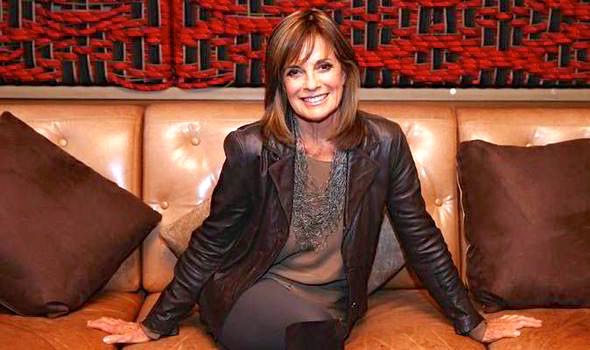
LONDON – Linda Gray walks quickly along the crowded streets of the British capital. “I smile, I wave, I move on,” says the actress, as eyes widen, fingers point and people whisper delightedly around her, “Sue Ellen. It’s Sue Ellen.”

Thirteen years after departing the worldwide hit “Dallas,” Gray is still remembered fondly for playing the long-suffering, hard-drinking Sue Ellen Ewing, wife of Larry Hagman’s swaggering, philandering oil man J.R.

She has kept a low profile mostly since then, doing the occasional television show (“Models Inc.,” “Melrose Place”), acting and directing in the theater and serving as a goodwill ambassador for the United Nations.

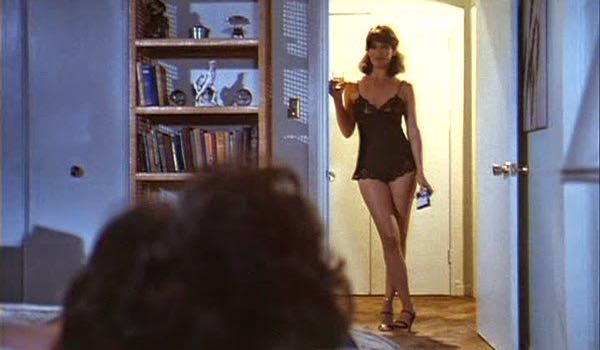
For the past few months, however, she has been the toast of London, starring as Mrs. Robinson in the boxoffice record-breaking run of the play “The Graduate” by Terry Johnson. Adapted from Charles Webb’s novel and the screenplay for the 1967 Mike Nichols motion picture, written by Calder Willingham and Buck Henry, the comedy has been running at the Gielgud Theatre in the West End since April 5, 2000.

Productions are planned in some 20 countries, and Kathleen Turner, who opened the play in London, will take it to Broadway later this year. Gray’s West End run concludes Saturday.

The show received raves from the British critics when it opened, and Turner has been succeeded by model Jerry Hall, Amanda Donohoe, Anne Archer and, in September, by Gray, of whom BBC London radio said, “At last, ‘The Graduate’ gets the Mrs. Robinson it deserves.”

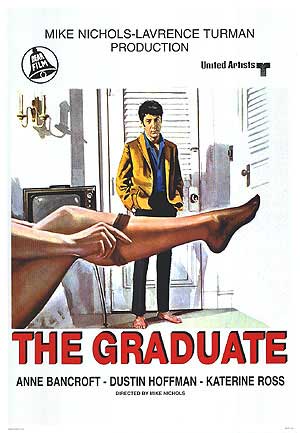
graduate posterFor Gray, it was a triumph with more than a touch of irony. To begin with, the sensuous female leg that dominated the key art for the original film was one of hers. She was modeling at the time, trying to break into acting, and the image was taken from a library of images she had posed for. “It was a day’s work,” she says now, though she agrees that figuring in one of the iconic images of ’60s movies is “kinda cool.”

When the play was announced, Gray asked her agent to let the producers know she was interested. She was turned down as too old. Four months later, they changed their minds: “I was stunned. I said, ‘I thought they said I was too old?’ I got a little feisty about it. People are so focused on age, and it’s a shame. You dishonour your uniqueness doing that. I’m sick and tired of women worrying about age and wrinkles and scars. It’s so unfair.”

Gray, who turned 61 in September, leapt at the part, although she admits to being “scared to come to the West End” to play the role of an older woman who seduces a young man and is seen fleetingly, in half-light, naked. She says, “Remembering to drop the towel was the big thing. I didn’t think about the critics. I thought, ‘If I do my best, some people will like it.’ ”

The tabloid Daily Mail sent not only its critic, it also sent a surgeon, a nutritionist and a therapist. Gray laughs: “They wanted to see what my body looked like, or if I’d had plastic surgery, or how I was holding up, I guess. At the end it was OK. They didn’t say a whit about my performance.”

'The Graduate' Linda Gray x600This story appeared in The Hollywood Reporter.
Posted in Interviews, News | Tagged , , | Comments Off on ‘Dallas’ star Linda Gray on being nude in ‘The Graduate’

FILM REVIEW: Robert Carlyle in ‘Black and White’

Black and White 1 x650

By Ray Bennett

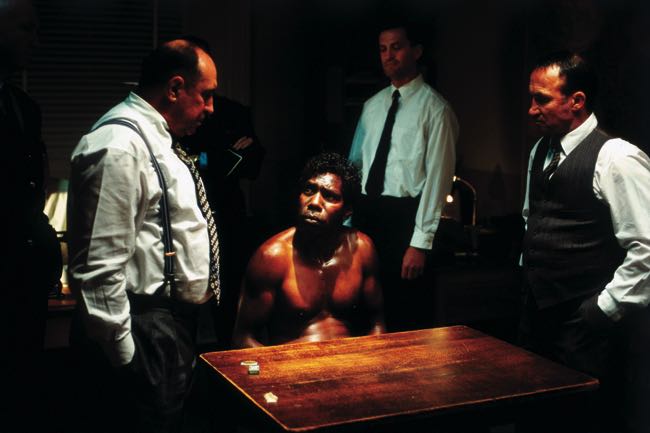
LONDON – In a remote desert town in South Australia in 1958, a 9-year-old girl is found raped and murdered. On the flimsiest evidence, local police almost immediately arrest a young Aboriginal man and obtain a confession. Only the efforts of a stubborn, inexperienced Adelaide lawyer stand between the accused and the hangman.

Craig Lahiff’s sturdy courtroom drama, based on real events, follows a predictable path and is unlikely to make substantial gains at the box office but it’s a laudable effort and certain to please fans of Robert Carlyle.

The “Full Monty” star plays the obstinate lawyer David O’Sullivan whose dislike of the antiquated British-based Australian judiciary drives him to take seriously a case he’s obliged to take without a fee. He quickly learns that the Aboriginal Max Stuart, played with unsentimental grace by David Ngoombujarra, is illiterate and put his mark on a confession he couldn’t read.

Black and White 2 x650

When it turns out that Curtis was in police custody for being drunk at the time the murder took place, it appears a dismissal is inevitable. But the pathologist changes her mind and fixes the death outside the timeframe of his alibi.

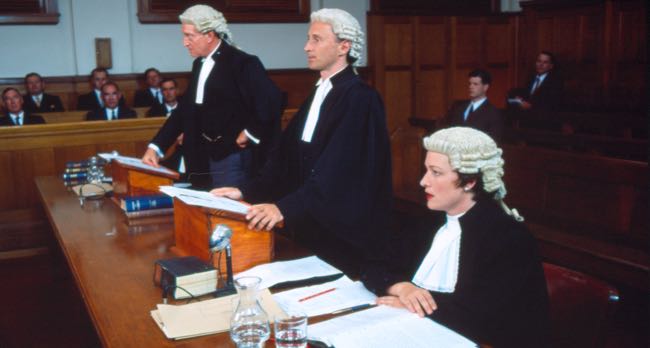
Only when he’s sent for trial does Curtis claim that the police beat him in order to obtain the confession. By now, O’Sullivan is going head-to-head with a pillar of the judicial establishment, Roderic Chamberlain, played with typical elegance and power by Charles Dance.

More evidence emerges that tends to suggest Curtis’ innocence when a compassionate priest becomes involved but he is convicted and sentenced to hang. O’Sullivan’s fight to win appeals goes all the way up to a Royal Commission, putting Curtis near the hangman’s door seven times while the local newspaper, published by one Rupert Murdoch, gets on the bandwagon to defend him.

Ben Mendelsohn plays the young Murdoch as a callow opportunist and the film suggests his enthusiasm for the campaign swiftly ended when he was threatened with prosecution for seditious libel.

The film dips a toe into the role of newspapers influencing trials but drops it as topic to focus on O’Sullivan’s class struggle with Chamberlain. Screenwriter Louis Nowra and director Lahiff develop that theme effectively and take the trouble to invest Chamberlain with considerable human dimension.

There is a clever scene in which the aristocratic hopeful for the Chief Justice’s chair snarls out his view of the case to his wife and their genteel friends, sparing them no brutal detail of the rape and murder as he believes they happened.

O’Sullivan runs into almost uniformly supercilious representatives of the British legal establishment, however, all with condescending stares and snooty voices. But the lawyer’s dependence on his reluctant but loyal partner, played sympathetically by Kerry Fox, is well drawn and at no point does Carlyle allow himself to showboat. His is a fully professional performance that shows no strain from the fact that he carries the film on his shoulders.

Lahiff shows little visual flair and the film will fit nicely on the small screen. It’s a grim tale not told in a grim way; an honorable argument not angry enough. A bit more of Chamberlain’s superb self-belief might have given the piece a lot more power.

Opens: UK Jan 9 (Tartan Films); Cast: Robert Carlyle, Charles Dance, Kerry Fox, Colin Friels, Ben Mendelsohn; Director: Craig Lahiff; Writer: Louis Nowra; Director of photography: Geoffrey Simpson; Production designer: Murray Picknett; Costume designer: Annie Marshall; Editor: Lee Smith; Producers: Helen Leake, Nik Powell; Not rated; running time, 100 minutes.

This review appeared in The Hollywood Reporter.
Posted in Film, Reviews | Tagged , , , , , | Comments Off on FILM REVIEW: Robert Carlyle in ‘Black and White’