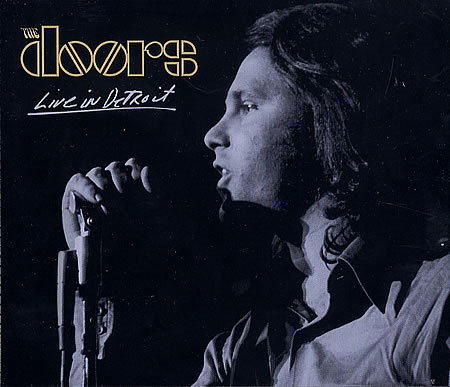
This review was written right after the concert that was recorded for “Live In Detroit” on the night of May 8, 1970.
By Ray Bennett | The Windsor Star | May 9 1970
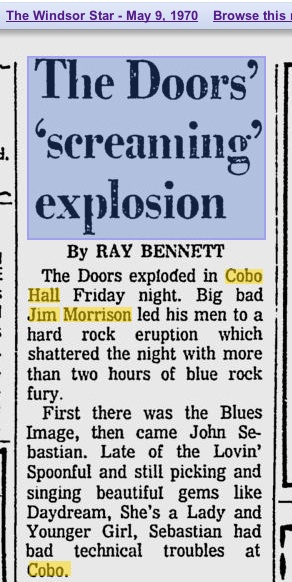
DETROIT: The Doors exploded in Cobo Hall Friday night. Big bad Jim Morrison led his men to a hard rock eruption that shattered the night with more than two hours of blue rock fury.
First there was the Blues Image, then came John Sebastian. Late of the Lovin’ Spoonful and still picking and singing beautiful gems like Daydream, She’s a Lady and Younger Girl, Sebastian had bad technical troubles at Cobo.
With only his nimble guitar-playing fingers for accompaniment the lad was fouled up with feed-back troubles with his microphones and a faulty strobe light that flashed maddeningly every few seconds during the majority of his performance. But the near-capacity crowd was with him all the way and yelled for his return when his performance was over.
 Intermission time. Lights were subdued. Morrison strolled insouciantly on stage in a multi-colored jacket and smoking a cigarette. The lights went down. The men began to play – organ, drums, one guitar. Still smoking and taking occasional sips from a bottle of beer, Morrison began to sing.
It was heavy stuff and if you didn’t know the songs you wouldn’t recognize them but that mattered less. No talk. One song runs into the next with Morrison – his jacket off and his stomach beginning to bulge a little over his belt these days – unsmiling and almost treating his adoring audience with disdain.
The audience was his. Completely. To those of us not hard-core Doors fans the reason for this at first was not clear. The music was loud and heavy with Morrison standing stiffly clutching the microphone screaming into its amplified recesses.
For almost an hour it went on like that. Pounding, driving, roaring sound that battered your ears and left your head spinning. The noise gains a monotony. But then the monotony settles into you.
You begin to wonder where it can go. Then you feel the monotony dissolve into something almost tangible. There are rhythm patterns and drifts and waves amid the compulsive sound. The band is really into it and getting tighter by the minute. Morrison is screaming.
Looking around you see other kids screaming back and suddenly you know what’s going on. You know what Morrison and the Doors are doing.
The loudest sound in the world, they say, is the human scream. Morrison is the human scream. The crashing repetitive music sets you up and dumps you right in the middle of a memory of when you last wanted to scream. For whatever reason – frustration, grief, anger, joy. But you didn’t scream, you held it in. Now there’s Morrison screaming at you, the music is pounding within you. You want to scream, and scream.
That’s how it is.
Friday night, Morrison showed the way and the audience at Cobo screamed their heads off. At what looked like the end of his set people were standing on their chairs yelling for more.
“We’re not going to let them throw us out, are we?” demanded Morrison. The crowd roared a defiant no. The organ intro to Light My Fire began and the kids on the main floor of the arena surged forward spontaneously. They never played Light My Fire better.
The Doors did another number then Morrison called for John Sebastian to join them. That’s when Morrison dropped his bombshell. Tension in the pace was almost tactile. The sense of defiance that Morrison personifies was rampant.
Then the lead Doorman let everyone in on the secret that the show was being recorded for possible release as an in-concert record album Live in Detroit. Flattered, the kids roared their approval.
The final song was This is the End. Kneeling down Morrison put the microphone between his legs, drew it up slowly to his face and let rip the most incredible gut-tearing scream of his career.
Exhausted he fell off the stage into the crowd of bra-less girls who grabbed him ecstatically. Stewards rushed to haul him back and the show was over.

Krakow festival puts some steel into film music
Composer Elliot Goldenthal and conductor Diego Navarro in concert at the Krakow Film Music Festival
By Ray Bennett
KRAKOW, Poland – Julie Taymor talks about meeting Paul McCartney and Yoko Ono when she made “Across The Universe”, which is filled with Beatles music. Taymor and McCartney alone sit next to each other in a screening room. “It’s quiet, and then I hear him singing along to one his songs, and I knew it would be all right,” Taymor says.
She meets John Lennon’s widow – “and her lawyer” – at her home in the Dakota Building. Taymor and partner Elliot Goldenthal have decided that Lennon’s song that goes “I want you, I want you so bad … “ will be perfect for a scene in which the lead character answers Uncle Sam’s demand that he must be drafted during the Vietnam War. Ono stares at Taymor: “You know he wrote that about me.”
Still, they got the movie made with the songs they wanted although the director says she will not listen to the soundtrack CD because of the edits and changes that were made. She says she loves what Goldenthal – and fellow music producers T-Bone Burnett and Teese Gohl – did with the arrangements for the film’s stars and assorted guest artists.
Goldenthal speaks of the “chromosomes” in a Beatles song: “If you try to duplicate their sound and you get one chromosome wrong, it’s a disaster, so you must go another way.”
They spoke at a 90-minute Q&A session on the Art of Collaboration that I moderated at the Krakow Film Music Festival in Poland. Artistic Director Robert Piaskowski invited them along with other filmmakers and composers for the annual three-day event staged first in 2008.
Tom Tykwer’s ‘Perfume: The Story Of A Murderer” accompanied by full orchestra and chorus in Krakow
Along with screenings, panel sessions and parties, there were three extraordinary concerts held in the vast Nowa Huta Steelworks, two of which I attended. Audience members had to negotiate the industrial area’s gates and then ride buses more than two miles to the vast central hall of an enormous building once called the Vladimir Lenin Steelworks, which remains a functioning factory known as the Tinning Plant of Arcelor Mittal Poland. For the festival, it was converted to a concert hall with 4,000 seats, a stage big enough for full orchestra and chorus, and a giant movie screen. What the venue lost in acoustics, it more than made up for in atmosphere.
On May 24, German filmmaker Tom Tykwer and fellow composer Reinhold Heil were on hand for a screening of Tykwer’s 2006 period drama “Perfume: The Story Of A Murderer”. The film screened in its entirety accompanied by the Sinfonia Cracovia conducted by Ludwig Wicki with two choirs and soprano Karolina Gorgol-Zaborniak.
Tykwer and Heil said it was the first time they had heard the complete score (which also featured music by Johnny Klimek) with orchestra and chorus combined. Budget restrictions meant that for the film the two parts were recorded separately.
The tale of a cruelly mistreated orphan who grows up to be a uniquely gifted but murderous creator of perfumes stars Ben Whishaw in the lead with Dustin Hoffman, Alan Rickman and Rachel Hurd-Wood. Some of the English dialogue was lost amidst the live music (although not to the local audience due to Polish sub-titles) but the picture is strange and engrossing and the live orchestral performance added to its epic moments.
The closing concert at the same venue featured excerpts from Jerry Goldsmith’s score for “Alien” (1979), James Horner’s for “Aliens (1986); Goldenthal’s for “Alien3” (1992), and John Frizzell’s for “Alien Resurrection” (1997) in a suite called the Biomechanical Symphony. With clips from the films and Sinfonia Cracovia conductor Diego Navarro’s fiery command of the baton, the music was dynamic and haunting, and made me reach for Twentieth Century Fox’s splendid Blu-ray “Alien Anthology” as soon as I got home.
Elliot Goldenthal and Julie Taymor, right, with Krakow radio personality Magdalena Miska-Jackowska and Varése Saraband’s Robert Townson, who presented the Goldenthal concert
The second part of the evening featured suites that Goldenthal had prepared of music from his films “Titus” (1999), “Frida” (2002) and “The Tempest” (2010) with Taymor, “Interview With The Vampire: The Vampire Chronicles” (1994) with frequent collaborator Neil Jordan, and “Batman Forever” (1995) with Joel Schumacher.
Composer and director winced when the mix jinxed phrases in the “Frida” score but they joined the general applause for Polish soloist Joanna Slowinska’s passionate delivery of Goldenthal’s Latin songs from the film and the contribution of Mexican players Ernesto Anaya, Pancho Navarro and Camilo Nu. Maestro Navarro threw himself into each piece and Goldenthal’s extraordinarily vivid score for “Titus” resounded around the vast walls of the steelworks.
The Krakow Film Music Festival is linked with the annual Tenerife International Film Music Festival in July in the Canary Islands where native-born Navarro is festival director. Along with Jan A.P. Kaczmarek’s Transatlantyk Poznan International Film and Music Festival in Poland in August and the World Soundtrack Awards at the Ghent Film Festival in Belgium in October, they have become major and much-valued events in the world of film music.
Krakow 2012 concert audience inside the former Lenin Steelworks [Photos courtesy of Krakow Film Music Festival