
By Ray Bennett
“All the world’s a stage,” says the doctor. “Hmm,” says the playwright, “I might use that.” As the playwright is William Shakespeare, you know he will.
One of the pleasures of the reinvented “Doctor Who” series, returning at 7 o’clock tonight on BBC1, is that the words are as much funs as the visuals.
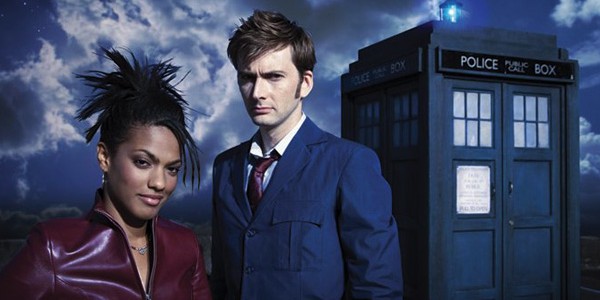
Writer Russell T Davies has done a dandy job on the show and David Tennant brings great flair and charm to the title role. He gets a new sidekick tonight as Freema Agyeman (pictured with Tennant above) joins the series as the smart and lively Martha, who is almost a doctor herself.
The Time Lord checks into the hospital where Martha works just in time for the entire building to be warped onto the moon in a plot involving monstrous aliens and a particularly nasty plasmavore who sucks the blood of humans through a straw.
With typical wit, the plasmavore comes in the form of a little old lady, Florence Finnegan, played by Anne Reid, and while she needs to refuel in order to obscure the fact that she is not human, she has no taste for it. As she aims her straw at a well-upholstered medical consultant, she sniffs, “Blood full of salty fats and vintage wines, and all those Michelin star sauces!”
The doctor gets to kiss Martha in the first show in order to make a genetic transfer, whatever that is, and he assures her: “It could save a thousand lives. It means nothing.” But it’s a smacker that leaves her gasping: “That was nothing?”
The Bard shows up on April 7 in the second episode with the cheeky title “The Shakespeare Code.” Gareth Roberts’s clever teleplay sends the time traveling Tardis back to Elizabethan times where three witches plan to use one of Shakespeare’s plays in order to take over the world.
Christina Cole has great fun as their leader, Lilith, a witch who alternately is beautiful and hideous. As she draws a gullible suitor into her lair, she leers: “Would you enter?” He pants: “I would.”
The sly dialogue continues as Martha views the witch’s brew of magical effects and says: “It’s all a bit Harry Potter.” To which the doctor replies: “Wait until you read Book 7! Oh, I cried.” He tells Shakespeare (Dean Lennox Kelly) to rage against the dying of the light but when the playwright’s ears perk up, he says, “No, it’s somebody else’s.”
Will takes a fancy to Martha but when the doctor insists “We can have a good flirt later,” the poet eyes him and says, “Is that a promise?” The time traveler shakes his head, “Ah, 57 academics just punched the air.”
If the rest of the 13-part series is as entertaining as the first two, then “Doctor Who” fans are in for a treat. As the doctor tells Shakespeare: “The play’s the thing. And yes, you can have that one.”



FILM REVIEW: ‘The Lives of Others’
By Ray Bennett
The McGuffin in Florian Henckel von Donnersmarck’s vastly overrated film about state repression, “The Lives of Others,” which opens in the U.K. on April 13, is a manual typewriter with a red ribbon. Just the thing you would choose if you were writing subversive reports about a cruel regime that bugs your home, films your every move and compromises the ones you love in order to trap you.
The machine is hidden beneath the floorboards in the apartment of a playwright named Georg Dreyman (Sebastian Koch) in East Berlin before the Wall came down. He uses it secretly to write reports about the evils of the obtuse but relentless state police, the Stasi, which are smuggled to the West for publication. The existence of the typewriter becomes the focus of an intense investigation by the Stasi that leads to betrayal, ruin and death.
The whole tension of the film comes to rest on the typewriter but it beggars belief as the screenplay establishes that the playwright famously writes in longhand and has someone transcribe his plays. As the entire weight of a corrupt and insidious political apparatus bears down on Dreyman, his unfortunate lover and his friends, you wonder if he wishes he’d just used his pen.
That’s not the only problem with the film, however. Perhaps the ugliness of East German repression is news to the folks who lived there, and airing it is a good thing. But it’s nothing new for those of us in the West who have been reading historians and novelists such as Len Deighton and John Gardner on the subject for decades.
Director and screenwriter Von Donnersmarck’s film is well acted, especially by Koch, Ulrich Muehe (pictured), as the most obsessive Stasi operative, and Martina Gedeck as Dreyman’s lover. But it has the dull grey look of a poor TV movie and what tension there is dissipates as chapters are tacked on at the end. The story’s resolution reflects sensitivity to viewers wishing to be comforted in their living rooms. It suffers from a wish to offer healing. The film cowers in the end instead of raging.
I’m in the minority on this as most critics raved about “The Lives of Others” and it picked up several prizes including the Academy Award for best foreign-language film. I find that baffling when the direct Oscar competition included cinematic treasures such as “Pan’s Labyrinth” and “Days of Glory,” not to mention those without nominations including “Volver,” “Letters from Iwo Jima” and “Apocalypto.”