

BERLIN FILM REVIEW: Boris Khlebnikov’s ‘Help Gone Mad’

help gone mad x650By Ray Bennett

BERLIN – Russian director Boris Khlebnikov’s enigmatic urban saga “Help Gone Mad” is very Russian indeed with long slow scenes and the driest comedy involving two lost men who take on some resemblance to Don Quixote and Sancho Panza.

Unlikely to attract audiences beyond Russian borders, the film offers a clash of moods from whimsy to the terror of a police force without control. Uninteresting visually, what enjoyment there is comes from the performances of the two leads.

Evgeny Syty plays a slow-witted country bumpkin who travels into Moscow for a day’s work after which he is promptly mugged and left without money, ID or shoes. A deluded old man (Sergey Dreiden) takes him home, feeds him a broth of boiled bones and insists that he stay.

The old man embroils him in his daily missions to save Moscow’s rundown citizens from the horrors of urban decay and together they tilt, if not at windmills, then at birdhouses, trash bins and park benches.

The old guy’s daughter (Anna Mikhalkova) brings his medicine and supplies of food but he resists her attempts to take care of him while she treats his visitor with disdain. The cockeyed threesome’s fate is bound to intersect with a lazy but brutal local police captain but the film takes what must be a very Russian view of the consequences.

Venue: Berlin International Film Festival, Forum; Cast: Evgeny Syty, Sergey Dreiden, Anna Mikhalkova, Alexander Yatsenko; Director: Boris Khlebnikov; Screenwriter: Alexander Rodionov; Director of photography: Shandor Berkeshi; Editor: Ivan Lebedev;  Producer: Roman Borisevich; Production: Koktobel; Not rated; running time, 118 minutes.

This review appeared in The Hollywood Reporter.

Posted in Berlin International Film Festival, Film, Reviews | Tagged , , , , | Comments Off on BERLIN FILM REVIEW: Boris Khlebnikov’s ‘Help Gone Mad’

BERLIN FILM REVIEW: John Hurt in ‘An Englishman in New York’

quentin_10612cBy Ray Bennett

BERLIN – When John Hurt portrayed Quentin Crisp in the movie “The Naked Civil Servant” 33 years ago, it gave Crisp the stardom he’d always craved. Now Hurt is back in the same role in “An Englishman in New York,” which shows what happened when Crisp landed as a gay icon in Manhattan.

Made for U.K. TV, the film will air there on ITV1 this year but it will make the rounds of international festivals and probably show up on a US cable channel. It deserves to be seen for another of Hurt’s exquisitely observed performances in which he furthers his claim to be the straight actor who has played the highest number of gay roles.

Written by Brian Fillis and directed by Richard Laxton, the film shows Crisp in his 70s when, having survived life as a gay man in the days when homosexuality was illegal, he flees still intolerant England for New York where his eccentric flamboyance is welcomed and celebrated.

Feeling right at home, he wins a green card after convincing immigration officials that he is truly one of a kind and is picked up by a savvy agent played by Swoosie Kurtz. He launches a career as a raconteur in an off-Broadway one-man show and becomes a movie reviewer for a Christopher Street magazine run by Philip Steele (Denis O’Hare).

Taking a tiny and shabby apartment — “Housework is a mistake,” he says — he becomes a fixture on what he calls “the champagne and peanuts” circuit. Crisp’s spontaneous words of wit and wisdom earn him an high place in the gay community with regular appearances on radio and TV but then one of his comments gets him in trouble.

“AIDS is just a fad,” he declares, and his gay audience, now starting to really suffer from the epidemic, turns away from him. Declining to retract or explain his remark, Crisp is dropped by his agent and editor until his eyes are opened when he gets to know young artist Patrick Angus (Jonathan Tucker), who is dying of AIDS.

Rescued by performance artist Penny Arcade (Cynthia Nixon), who puts him back on stage, and with Steele proving a loyal friend, the iconic figure lives into his 10th decade and once again wins over the gay community.

Crisp’s writing and performances provide much of the dialogue as he fulfils his destiny in becoming a dispenser of aphorisms that are rendered by Hurt with immense poise and charm. The actor is too good, however, not to reveal some of the man’s doubts and loneliness in a fully rounded performance.

Venue: Berlin International Film Festival, Panorama; Cast: John Hurt, Denis O’Hare, Jonathan Tucker, Swoosie Kurtz, Cynthia Nixon; Director: Richard Laxton; Screenwriter: Brian Fillis; Director of photography: Yaron Orbach; Production designer: Beth Mickle; Music: Paul Englishby; Costume designer: Joey Attawia; Editor: Peter H. Oliver; Producer: Amanda Jenks; Executive producers: James Burstall, Joey Attawia, Susie Field Production: Leopardrama; Sales: Leopard International; Not rated; running time, 74 minutes.

This review appeared in The Hollywood Reporter.


Posted in Berlin International Film Festival, Film, Reviews | Tagged , , , , | Comments Off on BERLIN FILM REVIEW: John Hurt in ‘An Englishman in New York’

BERLIN FILM REVIEW: Simon Bitton’s documentary ‘Rachel’

Après la mort de Rachel Corrie, tuée par un bulldozer israélienBy Ray Bennett

BERLIN – The drive to keep alive the name of a young American woman who died beneath a U.S.-made bulldozer driven by an Israeli soldier in Palestine continues in Simone Bitton’s sober documentary “Rachel.”

The idealistic Rachel Corrie (pictured below) was one of a team of activists from the U.S. and the U.K. who lived with Palestinian families in the most dangerous areas of the Gaza Strip in 2003 in an attempt to ameliorate the actions of the Israeli military demolishing homes close to the exclusion wall it had erected there.

rachel x325She was the subject of “My Name is Rachel Corrie,” a very moving 2005 play put together by actor Alan Rickman and journalist Katherine Viner. Starring Megan Dodds, it played at the Royal Court and then in London’s West End before getting a New York run in 2006.

Bitton’s documentary, which presents a very serious and unemotional examination of the available facts, will gain attention at festivals and among concerned communities but is unlikely to drum up mainstream audiences.

It is an important document, however, as it contains testaments by the civilian witnesses who were there when Corrie was killed as well as the official statements of key Israeli military commanders and administrators.

Corrie died when she and her colleagues attempted to stop a giant Caterpillar D9 bulldozer from clearing homes and other buildings in an area near Rafah. The soldiers testified that she died in a regrettable incident. Her associates and Palestinian witnesses say the driver of the 65-ton armored vehicle killed her deliberately.

Questions are raised about the speed and nature of the initial investigation and the official decisions that followed. Activists from England, Scotland and the States tell of their own experiences in Palestine, claiming that danger was constant from Israeli bullets and bulldozers.

The film presents everything in a matter-of-fact way but there is one sequence that will stick with any viewer. It’s shot from in front of one of the slowly moving monstrous bulldozers that, with its immense blade blocking the light, leaves no doubt that it would kill anything in its path.

Venue: Berlin International Film Festival, Forum;; Director-screenwriter: Simone Bitton; Director of photography: Jacques Bouquin; Editors: Catherine Poitevin & Jean-Michel Perez; Producer: Thierry Lenouvel; Production: Cine-Sud Promotions, Arte France Cinema, Novak Prod, RTBF; Sales: UMedia; Not rated; running time, 100 minutes.

This review appeared in The Hollywood Reporter.

Posted in Berlin International Film Festival, Film, Reviews, Theatre | Tagged , , , , , , , | Comments Off on BERLIN FILM REVIEW: Simon Bitton’s documentary ‘Rachel’

BERLIN FILM REVIEW: Sally Potter’s ‘Rage’

rage x650By Ray Bennett

BERLIN – Sally Potter’s Berlin competition film “Rage” shows that no matter how shallow, pretentious, self-regarding and irrelevant the fashion industry might be, there will always be a filmmaker who is more so.

The British writer and director has taken a bad idea for a radio play and tarted it up with highly stylised video that is supposed to be the work of a kid using a mobile phone camera. She roped in some big names including Judi Dench, Steve Buscemi, Eddie Izzard and Jude Law (pictured) to play characters at an unseen New York fashion show.

Plastered with makeup, they speak directly to the camera against a green, blue or red screen in a monotony of drivel having to do with what the kid with the camera is too clueless to go see for himself.

This involves some kind of accident involving one of the models and a shooting, but that’s unclear, and there’s not the slightest reason to care. Boxoffice will be limited to members of the filmmaker’s family, if that.

Reality TV appears to have eaten Potter’s brain as she thinks that everyone, including those who design, produce, own, photograph and write about haute couture on catwalk day will rush to sit in a kind of “Big Brother” confessional seat and tell all.

She clearly believes that only a kid would know that images shot on a digital camera can be uploaded onto some kind of interweb computer thingy that others can look at. She suggests that this is news to the rag trade.

Given complete rubbish to say and with such witless direction, the actors contribute uniformly the worst performances of their careers. It would be instructive to know what transvestite Izzard, for example, thinks of Law’s insulting posturing as a painted, bewigged and drooling model named Minx.

Many years ago, Yoko Ono made a picture in which she had people of all ages and stripes take their pants off and walk on a treadmill while she trained a motion picture camera on their naked bottoms. The entire film was a series of buttocks in motion, and compared to Potter’s “Rage” it was an absolute masterpiece.

Venue: Berlin International Film Festival, Competition; Cast: Judi Dench, Steve Buscemi, Eddie Izzard, Jude Law, John Leguizamo, Dianne Wiest; Director: Sally Potter; Screenwriter: Sally Potter; Director of photography: Steven Fierbeg; Music: Sally Potter, Fred Frith; Costume designers: Marina Draghici, Es Devlin; Editor: Daniel Goddard; Producer: Christopher Sheppard; Executive producers: Bob Hiestand, Christina Weiss Lurie Production: Adventure Pictures, VOX3 Films; Sales: Six Sales; Not rated; running time, 99 minutes.

This review appeared in The Hollywood Reporter.

Posted in Berlin International Film Festival, Film, Reviews | Tagged , , , , , , | Comments Off on BERLIN FILM REVIEW: Sally Potter’s ‘Rage’

BERLIN FILM REVIEW: Wolfgang Murmberger’s ‘The Bone Man’

bone man x650By Ray Bennett

BERLIN – Austrian comedian Josef Hader returns as lugubrious former police officer Simon Brenner in “The Bone Man,” the third of director Wolfgang Murmberger’s screen versions of the blackly comic crime novels by Wolf Haas.

Star, director and novelist combine on the screenplay just as they did on “Come Sweet Death” (2000) and “Silentium!” (2005), and Simon Schwartz returns as Brenner’s fusspot boss Berti, who kicks off a bizarre tale of blackmail, murder and cannibalism by sending the doleful ex-cop into the countryside to repossess a car.

Full of eccentric characters, strange twists and dead bodies, “The Bone Man” has a cheerfully twisted sense of humor and considerable tension as the head of a very odd family resorts to murder to get himself out a of a jam. Ranking with the noir thrillers of the early Coen Bros., the film’s boxoffice prospects are lively.

When Brenner is dispatched into the snowy hinterland to reclaim a yellow Beetle from a man named Horvath who is late with payments, he has no idea what he’s walking into. He tracks the man to the Loschenkohl Inn where he gets the cold shoulder from owner (Josef Bierbichler), his daughter-in-law Birgit (Birgit Minichmayr) and a waitress named Alex (Pia Hierzegger).

Deciding that Horvath has some connection to the inn, the mournful and reluctant repo man digs about unaware of the murderous drama going on around him. This involves Loschenkohl and a blackmailing pimp named Eugenev (Stipe Erceg) from Bratislava with the hotel owner’s layabout son Pauli (Christoph Luser), who is married to Birgit, determined to wreck his father’s plans to marry his young girlfriend (Edita Malovcic).

The growing intrigue and tension are underscored by what goes on in the basement of the inn where Loschenkohl has a machine with a lot of blades that renders leftovers from the restaurant — mostly the house specialty, chicken — that is sent in buckets to a nearby chicken farm.

The gruesome images of decimated and crushed bones add colorful counterpoint to the mayhem that takes place involving guns, car crashes, meat hooks and cleavers. But it’s all done with great flare and droll optimism despite the nefarious goings on and the unlikely romance of Brenner and Birgit is handled very deftly.

Venue: Berlin International Film Festival, Panorama; Cast: Josef Hader, Josef Bierbichler, Birgit Minichmayr, Christoph Luser, Simon Schwartz; Director: Wolfgang Murnberger; Screenwriters: Josef Hader, Wolfgang Murnberger, Wolf Haas; Director photography: Peter von Haller; Production designers: Andreas Donhauser, Renate Martin; Music: Sofa Surfers; Costume designer: Martina List; Editor: Evi Romen; Producers: Danny Krausz, Kurt Stocker; Production: Dor Film; Sales: Atrix Film; Not rated, running time, 121 minutes.

This review appeared in The Hollywood Reporter.

Posted in Berlin International Film Festival, Film, Reviews | Tagged , , , , | Comments Off on BERLIN FILM REVIEW: Wolfgang Murmberger’s ‘The Bone Man’

BERLIN FILM REVIEW: Rie Rasmussen’s ‘Human Zoo’

human zoo x650By Ray Bennett

BERLIN – Former Danish model Rie Rasmussen, who had the lead role in Luc Besson’s 2005 film “Angel,” writes, directs, edits and stars in her ambitious first feature, “Human Zoo,” about a woman haunted by her hellish experiences in the war-torn Balkans.

Set in racially divided Marseilles, with constant flashbacks to events in Kosovo, the film tries to mix a kind of fascist chic in its depiction of nihilistic crime in post-war Belgrade and a sober statement about changing borders and saving souls with a very mushy romance.

Rasmussen plays Adria, whose mother was a Serbian Christian and whose father was an Albanian Muslim, which means she faces hatred from all sides when the former Yugoslavia breaks into pieces. Saved from a killing squad by a ruthless soldier named Srdjan, who fires on his own officers and then deserts, she accompanies him to Belgrade where he begins a lucrative trade in gunrunning and murder.

Always a hoodlum but now with military training, Srdjan — played with terrific charisma by Nikola Djuricko — is fearless and merciless in his treatment of criminals on both sides of the law who have exploited the region’s chaos for their own ends.

He is a flat-out bad guy, but he grows to care for Adria and Rasmussen’s script gives him enormous charm even as he brutalizes innocents and murders men, women and even a child. Adria learns some of the ugly skills of his trade including how to handle a revolver and, with her hair cut in a jaunty bob, Srdjan even refers to them as Bonnie and Clyde.

The story of how Adria ends up in Marseilles is gradually revealed but meanwhile she has encountered a footloose American named Shawn (Nick Corey) and fallen in love. Helped by a local woman (Hiam Abbas) and her husband who also have adopted an immigrant girl, Adria resorts to violent action when the girl is kidnapped by Russian sex-traders.

The film demonstrates that Rasmussen has much to offer as a filmmaker although it’s too uneven to be called a success. The Belgrade scenes are performed in the local language and are entirely convincing but the sequences in Marseilles are done in English and suffer greatly for that.

Rasmussen holds the screen credibly but while Corey is a hunk and gets to frolic with Rasmussen in some very explicit sex play, he’s a lightweight compared to Djuricko, and the stilted English dialogue leaves even the wonderful Abbas (“The Visitor”) stranded.

Venue: Berlin International Film Festival, Panorama; Cast: Rie Rasmussen, Nikola Djuricko, Nick Corey, Hiam Abbass; Writer-Director: Rie Rasmussen; Director of photography: Thierry Arbogast; Production designer: Hugues Tissandier; Music: Illinav Illim; Costume designer: Joanna Georges Rossi; Editor: Rie Rasmussen; Producer: Luc Besson; Executive producer: Didier Hoarau; Production: Europacorp; Sales: Europacorp; Not rated; running time, 110 minutes.

This review appeared in The Hollywood Reporter.

Posted in Berlin International Film Festival, Film, Reviews | Tagged , , , , | Comments Off on BERLIN FILM REVIEW: Rie Rasmussen’s ‘Human Zoo’

BERLIN FILM REVIEW: Nick Oceano’s ‘Pedro’

By Ray Bennett

BERLIN – With the story of Pedro Zamora, the Cuban-born youngster who contracted the HIV virus at age 17 and told his story on MTV’s “The Real World” before dying young, “Pedro” is a film that wears its heart on its sleeve.

Produced by MTV and the folks who make the reality series, it portrays characters who almost all end up doing the right thing in support of a likeable young man who faced up to his fate with fortitude and generosity. Directed by first-timer Nick Oceano, the script is by Dustin Lance Black, Oscar-nominated screenwriter of the movie “Milk.”pedro x325

The film, which is squeaky clean and sentimental, will clearly get wide exposure thanks to MTV and will serve as an ongoing testament to Zamora and help in educating people about the ongoing dangers of AIDS. Gay communities and fans of the show also will respond, although the film’s lack of complexity may not intrigue more demanding audiences.

Pedro (Alex Loynaz) is seen auditioning for the TV show “The Real World: San Francisco” five years after being diagnosed as HIV positive. Those familiar with the show will recognize the other participants in the program, which was an attempt to observe young people interacting honestly and a cut above the likes of “Big Brother.”

The artificial atmosphere of a residence filled with camera crews is dealt with lightly, although Black’s script observes that MTV preferred Zamora to use his Spanish first-name Pedro rather than Peter, which all his friends called him.

Flashbacks tell the story of Zamora’s move from Cuba to Florida in the Mariel boatlift that saw several siblings left behind. It traces his relationship with his mother, who died of cancer when he was still quite young, and his adoring sister Mily (Justina Machado).

It depicts his love affair with another AIDs activist, Sean (Dajuan Johnson) and their betrothal live on MTV, and shows what an inspired lecturer Zamora became, talking to kids about how to protect themselves and relate to AIDS sufferers.

It’s all very sincere and inevitably touching but sometimes the acting is as stilted before the film camera as it appears to be in front of MTV’s cameras. Everyone works very hard to make it work, though, and given the bravery of its subject and the importance of the topic, being earnest is far from a bad thing.

Venue: Berlin International Film Festival, Panorama; Cast: Alex Loynaz, Justina Machado, Hale Appleman, Dajuan Johnson; Director: Nick Oceano; Screenwriter: Dustin Lance Black; Director of photography: Mark Putnam; Production designer: Denise Hudson; Music: Barbara Cohen; Costume designer: Natalia Collazo;Editor: Jonathan Alberts; Producers: Anne Clements, Chris Panizzon, Richard Glatzer, Wash Westmoreland; Executive producers: Jonathan Murray, Gil Godschein, Scott Freeman, Paris Barclay; Production: Bunim Murray Prods.; Sales: Bunim Murray Prods; Not rated; running time, 93 minutes.

This review appeared in The Hollywood Reporter.

Posted in Berlin International Film Festival, Film, Reviews | Tagged , , , , , | Comments Off on BERLIN FILM REVIEW: Nick Oceano’s ‘Pedro’

BERLIN: Great Cajun music in Tavernier’s ‘Electric Mist’

In the Electric Mist x650By Ray Bennett

BERLIN – There are several reasons to like French director Bertrand Tavernier’s handsome and atmospheric feature “In the Electric Mist,” which had its world premiere at the Berlin International Film Festival tonight, not least the sumptuous cinematography by Bruno de Keyzer, who has collaborated with the director more than once but most impressively on the jazz classic “Round Midnight“ (1986).

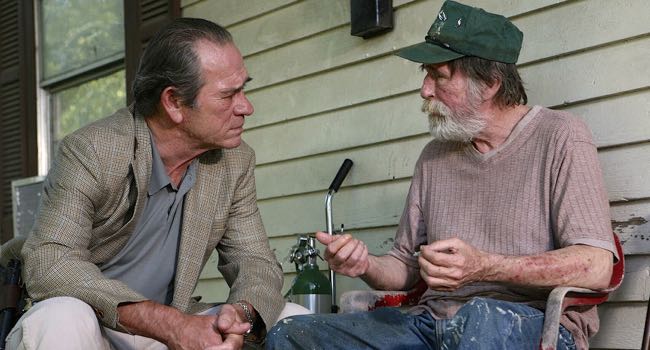
Tommy Lee Jones gives a shrewd and witty performance as crime writer James Lee Burke’s iconic Louisiana law officer Dave Robicheaux, in an adaptation by Jerzy Kromolowski and Mary Olson-Kromolowski of the bestseller “In the Electric Mist With Confederate Dead.”

Tavernier surrounds Jones with some fine actors in good form including Peter Sarsgaard, John Goodman, Mary Steenburgen and Kelly MacDonald. But the strong cast goes deep with Ned Beatty, James Gammon (pictured with Jones), Levon Helm, Bernard Hocke, Pruitt Taylor Vince, Justina Machado, Julio Cesar Cedillo and Walter Breaux.

One of the richest pleasures is the music, which combines an evocative score by Marco Beltrami (“Hellboy,” “Live Free or Die Hard”) with tracks by artists including Buddy Guy, who has a key role in the film as Sam “Hogman” Patin revealing crucial information to Det. Robicheaux.

Here’s what Tavernier had to say about the music in the production notes for “In the Electric Mist”:

On Marco Beltrami: “From day one, I wanted to work with him because he’d impressed me with his scores for ‘The Three Burials of Melquiades Estrada’ and ‘3:10 to Yuma’. He was thrilled because most of the time in Hollywood, composers are hired when the shoot wraps. He even went to Louisiana to get the feel of Cajun music and talk with musicologists. This helped us determine ‘way in advance the use of percussion instruments or of the accordion, or of the different musical themes. Besides, he gave me leeway to do what I wanted during sound mixing since he recorded all the instruments on a separate track.”

On using sourced tracks: “This is music I personally picked, like Clifton Chenier’s ‘I’m a Hog For You’ and ‘Coming Home’. Or like Michael Doucet’s ‘Rendez-moi Pauline’ and ‘J’ai passé devant ta porte’, which I found out about thanks to the Cajun crew members and fell in love with. For the ending, I used a Handel aria because I wanted to break away from the Cajun musical atmosphere we’d grown accustomed to – I then needed religious music that matched the crane camera work and the mist over the graveyard.”

Posted in Film, Music, Notes | Tagged , , , , , | Comments Off on BERLIN: Great Cajun music in Tavernier’s ‘Electric Mist’

BERLIN FILM REVIEW: Lucia Puenzo’s ‘The Fish Child’

fish child x650By Ray Bennett

BERLIN – Argentinean writer-director Lucia Puenzo has followed up her successful first film, 2007 Cannes Critics Week winner “XXY,” with “The Fish Child” (El nino pez), which, despite its unfortunate title, is a satisfying noirish tale that works well as a thriller and an intriguing love story.

The title, which no doubt resonates better in Spanish, refers to a surrealistic element that the film could easily do without, having to do with a fantasy about an underwater creature that guides the souls of lost children.It doesn’t get in the way of the central tale, however, which involves the romance of two attractive young women who dream of escaping bourgeois Buenas Aires and going to set up house together by a lake in rural Paraguay.

Lala (Ines Efron), the daughter in a wealthy but dysfunctional family, has had eyes only for Ailin (Mariela Vitale), a Guarani maid from Paraguay, since she came to work at the house when Lala was 13. Ailin responds and over time they become lovers and confidantes and start to make dreamy plans.

The Guarani girl is a seductive attraction to all comers, however, including Lala’s father, a controversial judge whose affairs are mixed up with a corrupt police chief. Things go badly wrong when the judge dies suddenly just as Lala and Ailin are ready to make their getaway. Lala makes it to Paraguay, while Ailin is accused of killing the judge and sent to prison.

Puenzo’s tale, based on her own novel, follows Lala as she discovers some harrowing truths about Ailin’s youth and determines to free her lover so they can fulfill their dream. With the police chief involved in using prison inmates as party girls, the film turns into a suspenseful thriller as Lala, with some help, goes to Ailin’s rescue.

Well-paced and absorbing, the film boasts winning performances by the two leads and there is typically fine music by Andres Goldstein and Daniel Tarrab.

Venue: Berlin International Film Festival, Panorama; Cast: Ines Efron, Mariela Vitale, Pep Munne; Director: Lucia Puenzo; Screenwriter: Lucia Puenzo; PDirector of photography: Rodrigo Pulpeiro; Production designer: Mercedes Alfonsin; Music: Andres Goldstein & Daniel Tarrab, Laura Zisman; Costume designer: Julio Suarez; Editor: Hugo Primero; roducers: Luis Puenzo, Jose Maria Morales; Executive producers: Fernando Sirianni, Miguel Morales, Claire Dornoy; Production: Historias Cinematograficas, Wanda Vision, MK2; Sales: MK2; Not rated; running time, 96 minutes.

This review appeared in The Hollywood Reporter.
Posted in Berlin International Film Festival, Film, Reviews | Tagged , , | Comments Off on BERLIN FILM REVIEW: Lucia Puenzo’s ‘The Fish Child’

BERLIN FILM REVIEW: Yoav Shamir’s ‘Defamation’

defamation x650By Ray Bennett

BERLIN – Israeli filmmaker Yoav Shamir tackles the thorny and provocative issue of anti-Semitism in his documentary “Defamation” and finds a deep divide between Jews who see it everywhere and Jews who find it nowhere, least of all in America.

The film is presented as the journey of a young man who has grown up in Israel without experiencing anti-Semitism on a quest to discover what it is and how it affects people.

Taking an understated but determined approach, he variously interviews his grandmother, blacks and Orthodox Jews who are neighbors in New York, rabbis, professors, Israeli school kids on a trip to a German concentration camp imposed on occupied Poland, and members of the Anti-Defamation League.

Everyday folk display the usual type of ignorance about people they hardly know and the scholars argue fiercely from opposing perspectives and deliver scathing diatribes about right-wing politics in Israel, while the rabbis appear the most sanguine about prejudice in modern life.

The fiercest opponents turn out to be in the United States, where Prof. Norman Finkelstein, who has written about what he calls “the Holocaust industry,” and Abraham Foxman, who is the very active National Director of the ADL, are vocal enemies.

Each was touched personally by the Holocaust but they hold opposing views on the nature of anti-Semitism and its impact on the world in general and Israel in particular. Their divide is profound and passionate, and Shamir takes time to allow both of them to make their case.

The most affecting scenes, however, involve the class of Israeli teenagers on a visit Auschwitz. They speak beforehand of how they are taught that anti-Semitism flourishes everywhere in the world and that by traveling beyond their nation’s borders they are constantly at risk.

Shamir uses his camera as an unblinking but compassionate observer as the youngsters make the emotional journey from giggling innocence and guarded fear into the camp’s horror where the crushing images leave them distraught and weeping, and then angry.

Their plight causes the director to offer the thought that perhaps it’s time to stop dwelling on the past, as horrific as it has been. Maybe, he says, it’s time to live in the present and look to the future.

Venue: Berlin International Film Festival, Forum; Director, screenwriter: Yoav Shamir; Director of photography: Yoav Shamir; Music: Mischa Krausz; Editor: Morten Hojbjerg; Producers: Karoline Leth, Sandra Itkoff, Philippa Kowarski, Knut Ogris Production: SF Film Production, Knut Ogris Films, Cinephil, Reveal Prods; Sales: Cinephil; Not rated; running time 91 minutes.

This review appeared in The Hollywood Reporter.

Posted in Berlin International Film Festival, Film, Reviews | Tagged , , | Comments Off on BERLIN FILM REVIEW: Yoav Shamir’s ‘Defamation’