By Ray Bennett
LONDON – As pretty as an English village green in summer and as bracing as a winter’s meadow brook, the BBC-TV’s new five-part period drama “Cranford”, which starts on Sunday, is an instant classic.
Starring some of the cream of British acting talent, the show is adapted from three novels by Elizabeth Gaskell. Her tales of the village of Cranford, not far from Manchester, in the mid-1800s have been rendered with loving precision by a cast and crew in top form.
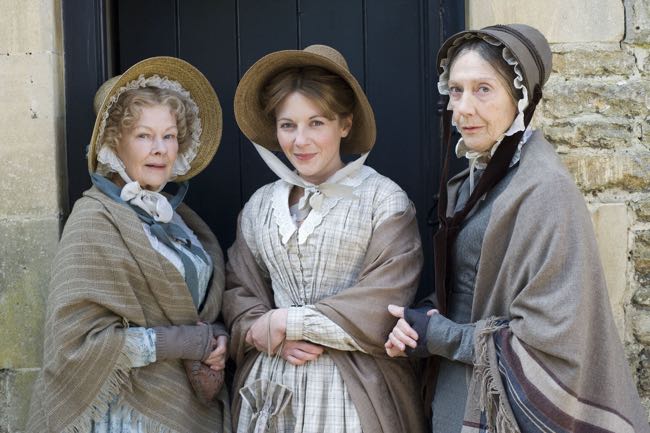
Like jewellers who find the most brilliant lights in little gems, in this case gems of dialogue and expression, the series features a wonderful cast of British actors including Judi Dench, Lisa Dillon and Eileen Atkins (pictured), Imelda Staunton, Francesca Annis, Jim Carter, Philip Glenister and Michael Gambon.
It’s as sharp as an old lady’s glance from behind curtains and as exquisitely lacerating as the lash of a Victorian spinster’s tongue. Made by Chestermead for the BBC and WGBH Boston, it’s a guaranteed audience pleaser with lovely photography that features beautiful English costumes, sets and locations.
Filmed mostly in and around Lacock and West Wycombe, where the mansion is Lady Ludlow’s house, the series also features scenes shot at Dorney Court, the Hambleden and Ashridge estates.
Produced by the BBC and WGBH Boston in association with Chestermead, the series has been given a magical touch by creators Sue Birtwistle and Susie Conklin. Heidi Thomas’ dialogue is a constant delight, and director Simon Curtis draws performances from his cast to match the best they have ever done.
Dench and Atkins set the tone immediately as two proper spinster sisters, Matty and Deborah Jenkins, who welcome into their village home young Mary Smith (Lisa Dillon), whose family in Manchester is in crisis.
The village has other newcomers in the form of Capt. Brown (Jim Carter) and his two daughters, Jessie (Julia Sawalha) and her unseen older sister who is seriously ill. Her fate will involve the Jenkyns sisters more than they would prefer but that duty obliges.
Young Dr. Harrison (Simon Woods) also is a fresh face in the village and he brings with him some new medical procedures that will help shake up old habits when carpenter Jem Hearne (Andrew Buchan) fractures his arm badly and faces amputation.
Meanwhile, at the big house, Lady Ludlow (Francesca Annis) is planning her annual garden party with the help of estate manager Mr. Carter (Philip Glenister) and she is very selective about the girls she hires to help. Staggered to discover that one applicant can read and write, Lady Ludlow declares: “She is equipped beyond her station; the proper order of the world will be undone.”
Hovering everywhere is the village gossip, Miss Pole (Staunton), who keeps all informed in timely fashion. In the second episode, Gambon’s Mr. Holbrook will arrive to upset Miss Matty’s world and there is the threat of a new railway line that will come to change the village even more. Viewers will hardly be able to wait.
Norman Mailer’s writing skill on display in ‘The Fight’
By Ray Bennett
The books of Norman Mailer, who died today at 84, proved of such little interest to filmmakers that he directed adaptations of some of them himself including “Maidstone” (1970) and “Tough Guys Don’t Dance” (1987).
Lawrence Schiller made an Emmy-winning NBC miniseries of “The Executioner’s Song” starring Tommy Lee Jones as death row convict Gary Gilmore in 1982. The only other feature of note was Raoul Walsh’s 1958 version of Mailer’s World War II novel “The Naked and the Dead” starring Aldo Ray and Cliff Robertson.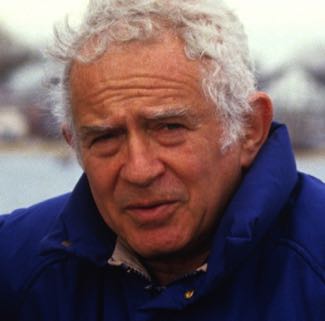
For my money, Mailer’s best writing was his journalism as in “The Executioner’s Song” but especially in his superb boxing yarn “The Fight,” which described the 1974 encounter between Muhammad Ali and George Foreman in Zaire known as the Rumble in the Jungle. Here’s an excerpt:
“Foreman’s arms flew out to the side like a man with a parachute jumping out of a plane, and in this doubled-over position he tried to wander out to the center of the ring. All the while his eyes were on Ali and he looked up with no anger as if Ali, indeed, was the man he knew best in the world and would see him on his dying day.
“Vertigo took George Foreman and revolved him. Still bowing from the waist in this uncomprehending position, eyes on Muhammad Ali all the way, he started to tumble and topple and fall even as he did not wish to go down. . . . He went over like a six-foot sixty-year-old butler who has just heard tragic news. . . .”
Here’s where to find it