
 By Ray Bennett
BERLIN – There are several reasons to like French director Bertrand Tavernier’s handsome and atmospheric feature “In the Electric Mist,” which had its world premiere at the Berlin International Film Festival tonight, not least the sumptuous cinematography by Bruno de Keyzer, who has collaborated with the director more than once but most impressively on the jazz classic “Round Midnight“ (1986).
Tommy Lee Jones gives a shrewd and witty performance as crime writer James Lee Burke’s iconic Louisiana law officer Dave Robicheaux, in an adaptation by Jerzy Kromolowski and Mary Olson-Kromolowski of the bestseller “In the Electric Mist With Confederate Dead.”
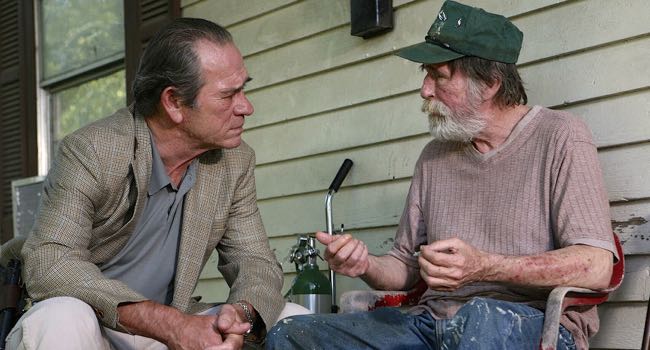
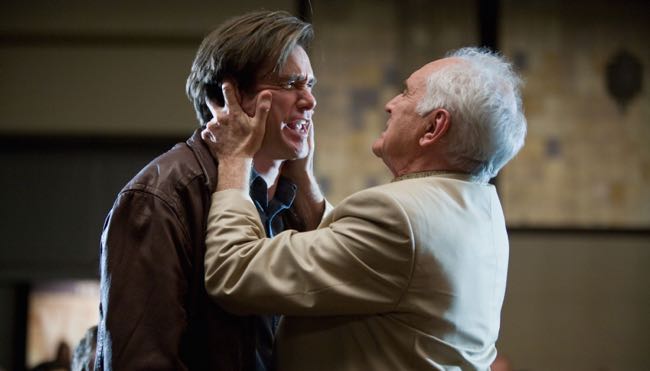
Tavernier surrounds Jones with some fine actors in good form including Peter Sarsgaard, John Goodman, Mary Steenburgen and Kelly MacDonald. But the strong cast goes deep with Ned Beatty, James Gammon (pictured with Jones), Levon Helm, Bernard Hocke, Pruitt Taylor Vince, Justina Machado, Julio Cesar Cedillo and Walter Breaux.
One of the richest pleasures is the music, which combines an evocative score by Marco Beltrami (“Hellboy,” “Live Free or Die Hard”) with tracks by artists including Buddy Guy, who has a key role in the film as Sam “Hogman” Patin revealing crucial information to Det. Robicheaux.
Here’s what Tavernier had to say about the music in the production notes for “In the Electric Mist”:
On Marco Beltrami: “From day one, I wanted to work with him because he’d impressed me with his scores for ‘The Three Burials of Melquiades Estrada’ and ‘3:10 to Yuma’. He was thrilled because most of the time in Hollywood, composers are hired when the shoot wraps. He even went to Louisiana to get the feel of Cajun music and talk with musicologists. This helped us determine ‘way in advance the use of percussion instruments or of the accordion, or of the different musical themes. Besides, he gave me leeway to do what I wanted during sound mixing since he recorded all the instruments on a separate track.”
On using sourced tracks: “This is music I personally picked, like Clifton Chenier’s ‘I’m a Hog For You’ and ‘Coming Home’. Or like Michael Doucet’s ‘Rendez-moi Pauline’ and ‘J’ai passé devant ta porte’, which I found out about thanks to the Cajun crew members and fell in love with. For the ending, I used a Handel aria because I wanted to break away from the Cajun musical atmosphere we’d grown accustomed to – I then needed religious music that matched the crane camera work and the mist over the graveyard.”



Angelo Badalamenti’s ‘Edge of Love’ my pick of 2008 film scores
By Ray Bennett
Vanity Fair has an interesting rundown of 11 potential candidates for this year’s film score awards. It’s a good list with many of the always deserving usual suspects. Good bets for Oscar nominations include Alberto Iglesias for “Che,” James Newton Howard for “Defiance,” and Thomas Newman for “Revolutionary Road.”
It’s hard not to escape the feeling, though, that while the “Revolutionary Road” score is atmospheric and haunting, director Sam Mendes must have temped his film with Newman’s score for “American Beauty.” Given the popularity of “WALL-E,” Newman’s delightful music for that picture seems like a hotter prospect just as A.R. Rahman’s excellent work should benefit from all the buzz about “Slumdog Millionaire.”
Mychael Danna’s score for Atom Egoyan’s “Adoration” was as good as anything this year but it won’t be eligible for the Academy Awards until next year. Other scores deserving attention in 2008 were “Alexandra,” Andrey Sigle; “Quantum of Solace,” David Arnold; “Synecdoche, New York,” Jon Brion; and “The Wrestler,” Clint Mansell.
My pick for this year’s awards, however, is the typically rich and melodic music written by Angelo Badalamenti for the overlooked Dylan Thomas picture “The Edge of Love” directed by John Maybury.
The Universal soundtrack album is a mix of songs performed by star Keira Knightley (pictured with Sienna Miller) with a couple of tracks by the glorious Madeleine Peyroux and Beth Rowley. Still, there’s plenty of music included from Badalamenti, who is best known for all those scores that made David Lynch’s films seem better than they were and who is long overdue for Oscar attention.