
CANNES FILM REVIEW: Fatih Akin’s ‘The Edge of Heaven’

The-Edge-of-Heaven-e1333751079339

By Ray Bennett

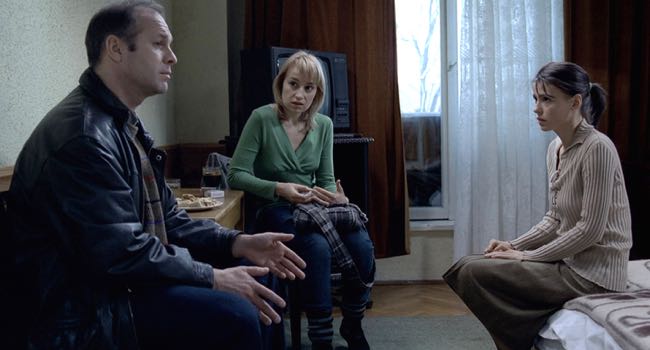
CANNES – Director Fatih Akin continues his insightful exploration of the things that divide and bridge different cultures and generations in his absorbing In Competition film “The Edge of Heaven.”

Like his 2004 Berlin Golden Bear winner “Head-On,” the film deals with Turkish folk living in Germany but this time he brings his story back to Istanbul.

Love was his topic in the earlier film, and now Akin turns his attention to death. It may not be a wise thing to label the major chapters announcing the deaths of key characters, but he tells their stories with flair and compassion.

Audiences that responded to “Head-On” will be pleased with “Heaven,” and festival and art house prospects look good.

The director, who also wrote the script, achieves a keen-eyed view of the Turkish expatriates in this film as he sustains his remarkable ability to make them universal.

It starts in Germany with the Turkish immigrant Ali (Tunnel Kurtiz), a crusty retired widower whose son Nejat (Baki Davrak) is a successful academic. Uncouth but charismatic, Ali still seeks pleasures of the flesh, which is how he meets Yeter (Nursel Kose), a severely beautiful Turkish woman who works in a brothel. Taken with her charms and pleased to be able to speak his native tongue, Ali proposes that he become her sole customer and asks her to move in with him.

Having been threatened by Muslim men who tell her she must give up her way of life, Yeter accepts Ali’s offer. Near is tolerantly amused by this turn of events but contentment is brief as there is darkness in his father’s character that leads to a fatal confrontation.

Meanwhile, Yeter’s daughter has gone missing in Istanbul and Nejat tries to find her. On a visit to that city, he falls in love with a German bookshop that is up for sale and, as he’s a professor of the language, he buys it. So now, he’s a very German Turk back in Turkey.

The film then moves to introduce Yeter’s daughter Ayten (Nurgel Yesilgay) who is involved with an underground group i Turkey. When she winds up with a gun in her possession following a street protest, she hides the gun and flees to Germany to seek asylum. There, she meets Lotte (Patrycia Ziolkowska) and they become lovers to the disapproval of Lotte’s mother, Susanne (Hanna Pchygulla).

When Ayten’s appeal is rejected, she is returned to Turkey and imprisoned for offences against the state. Lotte becomes a German ex-patriot in Turkey and the very human dilemma is viewed from another angle.

Attracted by the German books, Lotte goes to the bookstore and meets Najet, who offers her a room. As she has been warned never to mention Aynet’s name, the two never learn that they are seeking the same person. When Lotte visits her lover in jail, Aynet asks her to find the hidden gun and fate takes another turn.

Akin weaves their stories with clarity event as it becomes apparent that he has time-shifted certain scenes, and he makes observant sense about the fragility of human connections. Rainer Klausmann’s cinematography captures the contrasting cities of Hamburg and Istanbul vividly.

The acting is fine throughout with Kose and Schygulla especially effective as mothers who see themselves all too clearly in their daughters. It is only late in the film that the German professors sees his father in himself and the final scenes speak profoundly of acceptance and forgiveness.




Posted in Film, Reviews | Tagged , , | 1 Comment

CANNES FILM REVIEW: ‘The Diving Bell and the Butterfly’

diving-bell-and-the-butterfly x650

By Ray Bennett

Julian Schnabel not only directed the splendid Festival de Cannes In Competition film “The Diving Bell and the Butterfly” but he also assembled the marvelous soundtrack music.

The movie stars Mathieu Almaric (pictured with Emmanuelle Saigner) as French magazine editor Jean-Dominique Baupy, who was paralyzed by a stroke but still managed to write his life story. Continue reading →

Posted in Festival de Cannes, Film, Music, Reviews | Tagged , , , , | Comments Off on CANNES FILM REVIEW: ‘The Diving Bell and the Butterfly’

CANNES FILM REVIEW: Angelina Jolie in ‘A Mighty Heart’

'A Mighty Heart' Angelina Jolie x650

By Ray Bennett

CANNES – Michael Winterbottom’s expertly fashioned documentary-style drama “A Mighty Heart” relates the intense manhunt launched in Pakistan when jihadists kidnapped Wall Street Journal reporter Daniel Pearl in 2002. Angelina Jolie delivers a well-measured and moving performance as the reporter’s wife, Mariane. Continue reading →

Posted in Festival de Cannes, Film, Reviews | Tagged , , , , , | Comments Off on CANNES FILM REVIEW: Angelina Jolie in ‘A Mighty Heart’

CANNES FILM REVIEW: Ulrich Seidl’s ‘Import/Export’

import:export

By Ray Bennett

CANNES – Ulrich Seidl’s “Import /Export” is a tawdry little film ostensibly about the cultural clashes that result from the proximity of former Soviet states, such as the Ukraine, to western nations such as Austria. There is a film to be made on the topic, but this isn’t it.

With an aimless script filmed inadequately, the picture is unlikely to make it much farther than its inexplicable inclusion In Competition here at Cannes.

As the title suggests, there are twin stories in the film with a Ukrainian nurse who seeks non-skilled employment in Austria while a pair of witless Austrian yobs end up in the Ukraine where they try to sell an outdated gumball machine.

If Sheriff Bell was upset with the state of Texas in the new Coen Bros. film, he should see the lazy decadence in parts of Europe as depicted by director Seidl. The film’s blurb says he used real nursing home patients and sex workers in the scenes that dominate the film and if that’s true then the film is guilty of gross exploitation.

The nurse (Ekateryna Rak) gets a job as a cleaner in a nursing home although nothing much happens except that the declining state of the bewildered patients is edited for laughs. The two Austrians unload the gumball machine and the older of the two (Michael Thomas) gives the younger man (Paul Hofmann) a lesson in what the need for money will make people do. This involves the sexual humiliation of a young woman in which the actor and the director are complicit.

If the picture had any shock value perhaps a case could be made for it but it doesn’t; it’s just vile and tedious.

Venue: Festival de Cannes; Cast: Ekateryna Rak, Paul Hofmann, Michael Thomas, Maria Hofstatter, Georg Friedrich, Natalija Epureanu, Erich Finsches; Director: Ulrich Seidl; Writers: Ulrich Seidl, Veronika Franz; Directors of photography: Edward Lachman, Wolfgang Thaler; Production designers: Andreas Donhauser, Renate Martin; Costume designer: Silvia Pernegger; Editor: Christof Schertenleib; Producers: Ulrich Seidl, Lucki Stipetic Production: Ulrich Seidl Film Production, Coproduction Office; Not rated; running time, 135 minutes.

This review appeared in The Hollywood Reporter.

Posted in Festival de Cannes, Film, Reviews | Tagged , , | Comments Off on CANNES FILM REVIEW: Ulrich Seidl’s ‘Import/Export’

The happy accident of Cannes delight, ‘The Band’s Visit’

Autosave-File vom d-lab2/3 der AgfaPhoto GmbH

By Ray Bennett

The best film so far at this year’s Festival de Cannes, by a country mile, is Eran Kolirin’s little gem, “The Band’s Visit”, and I’m so glad I stumbled upon it by accident.

A mix-up led me to the wrong screening but as soon as this delightful movie started, I knew I could not leave. It’s a shame and a mystery that it’s not In Competition.

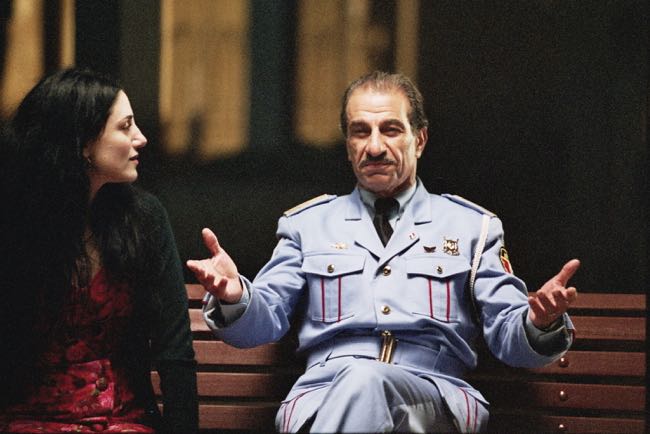
It tells a simple tale of a group of dignified Egyptian musicians on a trip to Israel who end up in the wrong town but encounter a night of magic. Sasson Gabai and Ronit Elkabetz (pictured below) star in a picture that is smart and tender, and filled with small moments of high comedy.

Duane Byrge’s review in The Hollywood Reporter says it all:

The Israelis don’t exactly put out the red carpet for an Egyptian police band in this radiant and wise comedy about a benign miscommunication between the two countries.

Set smack dab in the outer sands of Israel, “The Band’s Visit” (Bikur Hatizmoret) shows what you can do with virtually nothing for a set and no big boxoffice elements — you can make a terrific film about people.

Spry and laced with understated wisdom, “The Band’s Visit” could be a winner on the U.S. select-site circuit. Best, this glorious road show also posits larger themes, not only about the relations between the countries but of mankind. And it does so with such deferential grace and good humor that the grandness of the themes never get in the way of the entertaining scenario.

A “little” film with a great reach, it met a crescendo of applause in its Un Certain Regard screening. Underscored with droll comedy and counterpointed with unexpected revelations, this film is an oasis of creativity in the often barren bigness of a festival.

Autosave-File vom d-lab2/3 der AgfaPhoto GmbH

Posted in Festival de Cannes, Film, Reviews | Tagged , , , , , | Comments Off on The happy accident of Cannes delight, ‘The Band’s Visit’

CANNES FILM REVIEW: Li Yang’s ‘Blind Mountain’

12blin600

CANNES – Like Hollywood studios under the Hays Code from 1934 to 1967, London playwrights under the Lord Chamberlain for eons until 1968, filmmakers in China today must please the authorities before their movies are released to the world.

The Hollywood Reporter’s newly appointed Asian Bureau Chief, Beijing-based Jonathan Landreth, reports today that Chinese director Li Yang is re-editing “Blind Mountain,” which is in the Festival de Cannes sidebar Un Certain Regard, to get a release in China. Continue reading →

Posted in Festival de Cannes, Film, Reviews | Tagged , , , , | 2 Comments

CANNES FILM REVIEW: Coen Bros.’ ‘No Country For Old Men’

no_country_for_old_men x650

By Ray Bennett

CANNES – Joel and Ethan Coen’s In Competition film is titled “No Country for Old Men” but it is set in an unforgiving 1980s West Texas landscape that appears to be populated with nothing but old men. Lawmen, mostly, like Tommy Lee Jones’s Sheriff Bell, pining for the old days when outlaws weren’t relentless killing machines like the one who has come to terrorise his hardscrabble community.

The film attains an extraordinary level of tension as a fiercely dedicated drug runner named Anton Chigurh, played brilliantly by Javier Bardem, pursues a man who has stumbled upon and taken his money. The Coens’ typically superior filmmaking sustains the electrifying mood for most of the picture but they are undone by being too faithful to the source novel by Cormac McCarthy.

Plot holes, wrong-headed moves by key characters, cracker-barrel philosophising and a major climactic scene that takes place offscreen serve to undo all their fine work. The entire premise of the film is to pitch three men onto a path that will lead to a final reckoning but it just peters out.

There is a lot of carnage in “No Country For Old Men” and some of it has already taken place when Vietnam veteran Lwewelyn Moss (Josh Brolin) comes across the scene of what obviously is a big-time drug deal gone bad. Bodies litter the ground between shot-out vehicles, there’s a truckload of dope packed neatly and a satchel that contains millions of dollars.

One man remains alive and asks for water. Absurdly, for a season hunter on that arid terrain, Moss doesn’t have any. He takes the money back to the trailer he shares with a devoted young wife, played convincingly by Kelly MacDonald, but in the middle of the night he stricken with guilt. Not about taking the money but about leaving a dying man with no water. So he goes in the dark to the isolated killing scene where he knows there’s a vast quantity of drugs.

Inevitably, men with guns who have a proprietary interest in the contraband make their presence felt and Moss is fast on the run. Leading the chase is Chigurh, a man of perhaps East European extraction, who carries a tank of compressed air attached to the kind of bolt gun used to slaughter cattle. It sounds like something Carl Hiassen would come up with but Bardem plays the drug runner with such humourless conviction that his weapon of choice becomes truly threatening.

Chigurh, however, joins the list of implacable murders such as Hannibal Lector and the Terminator whose encounters with terrified innocent people are played for laughs/ Chigurh mostly just slays anyone he encounters but now and then he lets the toss of a coin decide someone’s fate.

Sheriff Bell is on the case, looking to prevent the madman from killing too many people, especially Moss, but Bell is not the Tommy Lee who always gets his man; this officer of the law is an ineffectual old windbag. Woody Harrelson has a brief and redundant role as a mistakenly cocky bounty hunter.

Brolin is terrific as the likeable country boy who sees his shot at the main chance and grabs it although mid-way through the film, when he has survived long enough to reach Mexico, he inexplicably does not stay there. His vet is tough and resourceful, though, and the film cries out for a resolution that, if not a happy one, would at least be satisfying.

Posted in Film, Reviews | Tagged , , , , , | Comments Off on CANNES FILM REVIEW: Coen Bros.’ ‘No Country For Old Men’

CANNES FILM REVIEW: Anton Corbijn’s ‘Control’

control x650

By Ray Bennett

CANNES — Anton Corbijn’s “Control,” which relates the short sad life of ’70s rocker Ian Curtis, is a dour affair but it boasts some terrific music not only from his band Joy Division but many other artists including David Bowie, Lou Reed, Iggy Pop and the Killers. Continue reading →

Posted in Festival de Cannes, Film, Music, Reviews | Tagged , , , , , | 2 Comments

CANNES FILM REVIEW: ‘4 Months, 3 Weeks and 2 Days’

4-months-3-weeks-2-days x650

By Ray Bennett

CANNES – Romanian filmmaker Cristian Mungiu’s In Competition entry “4 Months, 3 Weeks and 2 Days” is a harrowing tale of the grim lengths to which two young women will go to end an unwelcome pregnancy in a totalitarian society that is indifferent to their fate unless it involves punishing them. Continue reading →

Posted in Festival de Cannes, Film, Reviews | Tagged , , , , , , | Comments Off on CANNES FILM REVIEW: ‘4 Months, 3 Weeks and 2 Days’

Beautiful images and music in ‘My Blueberry Nights’

04_07_blueberry x650

By Ray Bennett

CANNES — Singer Norah Jones (pictured) stars in Wong Kar Wai’s ruminative road picture “My Blueberry Nights,” which opens the Festival de Cannes today, and she makes a fine impression in her acting debut although she doesn’t sing.

The voice everyone will leave the picture thinking about is that of Chan Marshall, the gifted singer and songwriter from Georgia who leads the hot outfit Cat Power and the Memphis Rhythm Band. Continue reading →

Posted in Festival de Cannes, Film, Music | Comments Off on Beautiful images and music in ‘My Blueberry Nights’